KARATE AS A SCIENTIFIC AND PHILOSOPHICAL DISCIPLINE
A Study of Its Styles, Development, Human Purpose, and the Philosophy of Professor Grand Master King Mohammadullah Omar Iman Dost
Abstract
Karate is not simply a method of fighting and it is not merely a competitive sport. From a scientific perspective, Karate is a complex system of human movement involving biomechanics, physiology, motor learning, coordination, balance, reaction, strength, flexibility, endurance, and psychological regulation.
From a philosophical perspective, Karate represents a transformation of physical power into disciplined human capability. The practitioner learns not only how to strike or defend, but also how to control the body, regulate emotions, develop concentration, respect others, and transform physical ability into personal and social responsibility.
Historically, modern Karate developed from Okinawan martial traditions and was subsequently systematized and disseminated in Japan and internationally. Several major traditions emerged, including Shotokan, Goju-ryu, Shito-ryu, and Wado-ryu. Other important systems, such as Kyokushin, Shorin-ryu, Uechi-ryu, and numerous derivative or independent organizations, expanded the Karate family. The Japan Karate Association identifies Shotokan as a major traditional form and emphasizes kihon, kata, and kumite as fundamental components.
1. What Is Karate?
Karate may be defined scientifically as:
A structured system of human movement and martial training that develops striking, defensive movement, body control, coordination, physical fitness, tactical decision-making, and psychological discipline.
The word Karate is generally associated with the Japanese expression meaning “empty hand.”
However, Karate should not be understood only as “fighting with empty hands.”
It contains several dimensions:
- Physical development
- Technical development
- Tactical development
- Psychological development
- Educational development
- Ethical development
- Cultural development
- Competitive development
Therefore, Karate can be studied simultaneously as a martial art, educational discipline, physical activity, and—under appropriate rules—as a combat sport.
2. Karate from a Scientific Perspective
Scientific analysis can examine Karate through several disciplines.
Biomechanics
Biomechanics studies how the human body produces and controls movement.
In Karate, biomechanics can analyze:
- punching mechanics;
- kicking mechanics;
- rotation of the hips;
- movement of the center of mass;
- balance;
- foot pressure;
- acceleration;
- force production;
- reaction time.
For example, a technically efficient punch is not simply a movement of the arm. It involves coordinated action through the legs, hips, trunk, shoulder and arm.
Physiology
Karate training can involve:
- muscular strength;
- power;
- aerobic capacity;
- anaerobic capacity;
- flexibility;
- coordination;
- neuromuscular control.
Motor Learning
Repeated practice develops the nervous system’s ability to perform complex movements more efficiently.
This is why Kihon, Kata and Kumite are important in many Karate systems.
The JKA specifically describes these three as central components of Shotokan practice.
3. Karate from a Philosophical Perspective
The philosophical question is deeper:
Why should a human being learn to control physical power?
The answer is not simply to become stronger.
Physical power without self-control can become destructive.
Therefore, martial training attempts to transform:
Power → Control → Discipline → Responsibility
This produces an important philosophical principle:
The purpose of mastering physical power is not necessarily to increase violence, but to increase the individual’s capacity for controlled action.
The Japan Karate Association similarly presents Karate as a way of developing body, mind and spirit together, rather than treating it simply as a points-based sport.
4. How Many Styles of Karate Exist?
There is no universally accepted exact number of Karate styles worldwide.
This is because “style” can mean different things:
- a historical lineage;
- a formally recognized school;
- a federation-recognized style;
- an organization;
- a technical variation;
- a founder’s system;
- a modern hybrid system.
Therefore, saying “Karate has exactly X styles” would not be scientifically precise.
A better academic statement is:
Karate consists of several major historical traditions and a large number of derivative, organizational and independent styles.
Four styles are particularly important in modern Japanese Karate:
- Shotokan-ryu
- Goju-ryu
- Shito-ryu
- Wado-ryu
These four are recognized by the World Karate Federation (WKF) framework and by the German Karate Federation.
Other important traditions include:
- Kyokushin
- Shorin-ryu
- Uechi-ryu
- Shito-kai
- Wado-kai
- Ashihara
- Shinkyokushin
- Yoshukai
- Fudokan
- and numerous other branches and organizations.
The Azerbaijan Karate Federation, for example, lists several systems including Ashihara, Fudokan, Full Contact/Shinkyokushin, Goju-ryu, Kudo, Shito-ryu, Shotokan and Wado-ryu within its national structure.
The German Karate Federation lists 22 styles/branches within its own recognized structure, demonstrating why the answer depends on the definition of “style.”
5. Shotokan-ryu
Founder/systematizer: Gichin Funakoshi and subsequent Shotokan tradition.
Shotokan became one of the most widely practiced forms of Karate.
Its training traditionally emphasizes:
- Kihon
- Kata
- Kumite
- strong stances;
- linear movement;
- precise technique;
- timing;
- distance;
- disciplined body mechanics.
The Japan Karate Association describes Shotokan as a major traditional form and explains that the name derives from Funakoshi’s pen name, “Shoto.”
Philosophical interpretation
Shotokan can be interpreted as a path from:
technical precision → discipline → self-control → character development.
6. Goju-ryu
Founder associated with modern system: Chojun Miyagi.
The name Goju is commonly translated as:
Hard–Soft
This reflects a central conceptual principle: hard and soft methods can complement one another.
Goju-ryu is particularly associated with:
- close-range movement;
- breathing practices;
- rooted posture;
- circular techniques;
- controlled power;
- conditioning.
Philosophical principle
Goju-ryu offers an interesting philosophical model:
Strength does not mean hardness alone; effective action requires the ability to alternate between hardness and softness.
This principle has applications beyond combat.
In life:
Rigidity can fail.
Excessive softness can also fail.
Wisdom requires adaptability.
7. Shito-ryu
Shito-ryu is associated with Kenwa Mabuni.
It is notable for its extensive technical and kata heritage and for incorporating influences from different Okinawan traditions.
It can be understood as an example of synthesis.
Philosophically, this is important:
A martial tradition can preserve historical knowledge while integrating different technical lineages.
Shito-ryu is also recognized among the four major styles in the WKF/EKF framework.
8. Wado-ryu
Wado-ryu is associated with Hironori Otsuka.
It developed through the interaction of Karate with Japanese martial traditions, particularly Jujutsu influences.
The name is commonly associated with:
“The Way of Harmony.”
This gives Wado-ryu a particularly interesting philosophical dimension.
Instead of meeting force with force at every moment, the practitioner can seek:
- evasion;
- timing;
- positioning;
- body movement;
- efficiency;
- harmony.
Philosophically:
The intelligent response is not always stronger force; sometimes it is better positioning.
9. Kyokushin
Kyokushin represents another major development in modern Karate.
It is particularly associated with:
- full-contact training;
- physical conditioning;
- endurance;
- toughness;
- fighting spirit;
- demanding kumite.
It demonstrates an important distinction:
Karate is not one uniform competitive experience.
Different styles can establish different relationships between:
- contact;
- conditioning;
- kata;
- kumite;
- competition;
- self-defense.
10. Karate as Martial Art versus Karate as Combat Sport
This distinction is essential.
Karate as Martial Art
The objective can include:
- self-development;
- discipline;
- technical mastery;
- tradition;
- self-defense;
- character development;
- philosophical education.
Karate as Combat Sport
The objective becomes more competition-oriented:
- winning matches;
- scoring;
- tactical competition;
- athletic performance;
- rules;
- referees;
- categories;
- tournament preparation.
Thus:
The same Karate tradition can function as a martial art in one context and as a combat sport in another.
11. Kihon, Kata and Kumite
A useful scientific model is:
Kihon — Fundamental Technique
The practitioner isolates and repeats basic movements.
Purpose:
motor learning + technical accuracy + body control
Kata — Structured Movement
The practitioner performs a predetermined sequence.
Purpose:
coordination + memory + technical integration + rhythm + concentration
Kumite — Partner Practice / Sparring
The practitioner interacts with another person.
Purpose:
timing + distance + reaction + tactical decision-making + controlled application
Together:
Kihon builds the vocabulary.
Kata organizes the vocabulary.
Kumite tests the vocabulary under interaction.
12. The Philosophical Evolution of Karate
Karate can be understood as a transformation:
Instinct
↓
Physical movement
↓
Fighting
↓
Technique
↓
Martial system
↓
Discipline
↓
Education
↓
Sport
↓
Science
This is one of the most powerful ways to understand Karate historically and philosophically.
13. The Human Being and Karate
Why does a modern human still practice Karate when survival no longer requires hand-to-hand combat in everyday life?
Because the purpose has expanded.
Ancient physical training was strongly connected with:
survival
Modern martial training can address:
health + discipline + education + confidence + coordination + self-control + competition + cultural identity
Thus the human body remains the instrument, but the purpose has evolved.
14. Introducing Professor Grand Master King Mohammadullah Omar Iman Dost
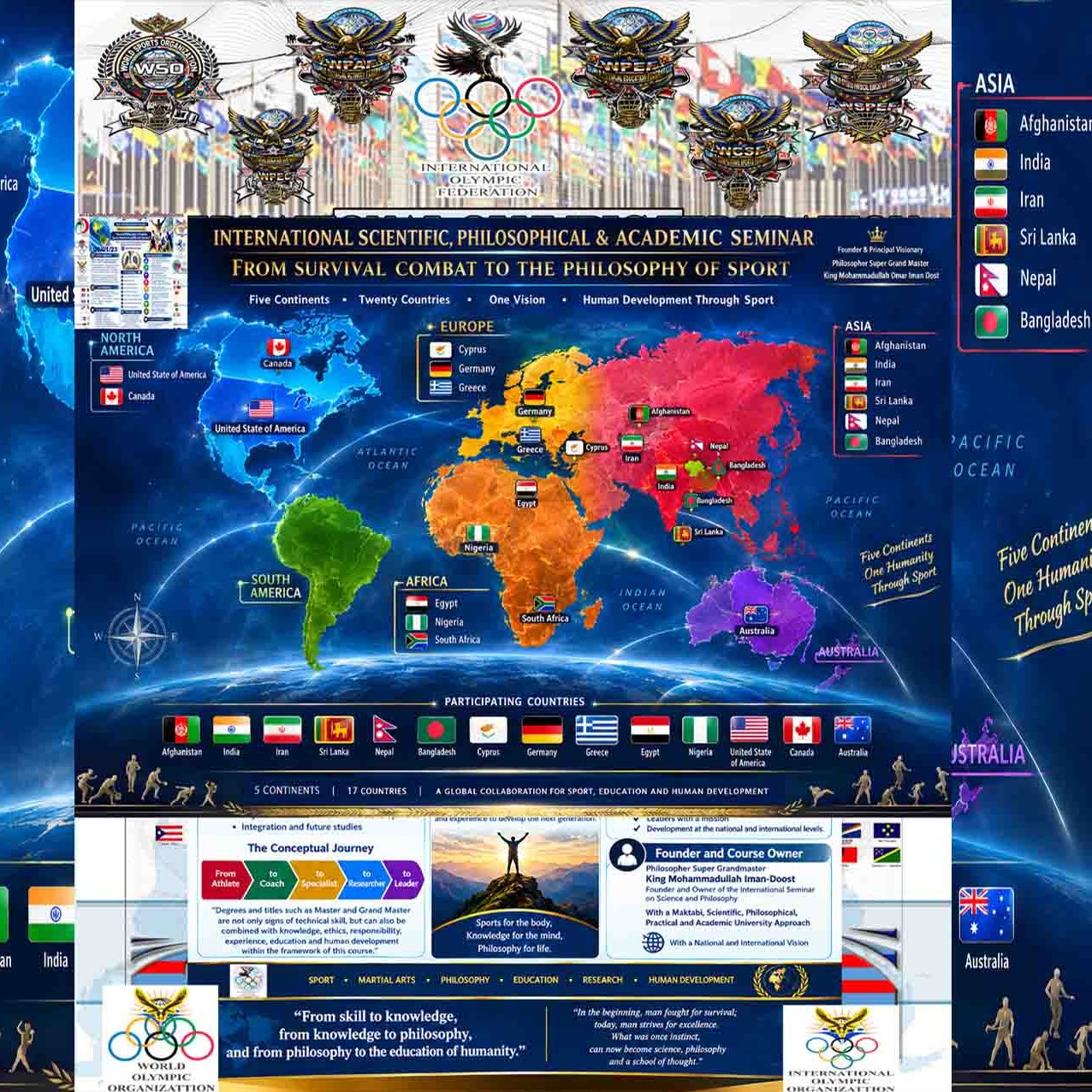
Publicly available material associated with his organizations describes Mohammadullah Omar Iman Dost as a martial artist, sports professional, sports educator, researcher and sports-organization founder, with activities spanning martial arts, combat sports, physical education, sports science and international sports development. The same material uses titles including Professor Grand Master, Super Grandmaster, Philosopher, and King of the World.
Those organizational biographies associate him with disciplines including:
- Boxing;
- Kickboxing;
- Brazilian Jiu-Jitsu;
- Wrestling;
- Muay Thai;
- Taekwondo;
- Mixed Martial Arts;
- sports education;
- sports science;
- physiology;
- biomechanics;
- sports philosophy.
The organization’s published biography also states that he has more than 20 years of experience in fighting arts.
For academic writing, however, it is important to distinguish between self/organizational descriptions and independently verified academic or institutional credentials. Therefore, titles such as “King,” “Super Grandmaster,” or “Philosopher” should be attributed as titles used by the associated organizations unless independent documentary evidence is available.
15. His Philosophical Position in the Context of Karate
Based on the public organizational material, the philosophy associated with Mohammadullah Omar Iman Dost can be positioned around several concepts:
1. Physical Excellence
The body should be developed through systematic training.
2. Intellectual Development
Physical education should not be separated from knowledge.
3. Discipline
Physical power must be controlled.
4. Sportsmanship
Competition should develop respect rather than uncontrolled aggression.
5. International Cooperation
Martial arts and sport can create communication among different cultures.
6. Human Development
The final objective should extend beyond winning a fight.
This can be expressed philosophically as:
“A trained body should become an instrument of an educated mind and a disciplined character.”
16. Scientific Model of the Karate Practitioner
A modern Karate practitioner can be studied through five interconnected dimensions:
Physical Dimension
Strength, speed, endurance, flexibility, balance.
Technical Dimension
Punching, kicking, blocking, footwork, combinations.
Tactical Dimension
Distance, timing, anticipation, decision-making.
Psychological Dimension
Attention, confidence, emotional regulation, resilience.
Philosophical/Ethical Dimension
Discipline, respect, responsibility and self-control.
Therefore, the complete practitioner is not simply:
a stronger fighter
but ideally:
a physically capable, technically skilled, psychologically controlled and ethically responsible human being.
17. Final Philosophical Conclusion
Karate can be understood at three different levels:
Level 1 — Body
Can the human body move effectively?
Level 2 — Mind
Can the human being understand, control and intelligently direct movement?
Level 3 — Character
Can physical power be controlled and used responsibly?
Therefore, the deepest philosophical meaning of Karate is not merely:
“How can I defeat another person?”
It is:
“How can I develop myself so that strength is controlled by intelligence, and intelligence is guided by responsibility?”
This is why Karate can simultaneously be studied as a martial art, a combat discipline, a competitive sport, a physical-education methodology, a cultural tradition, and a field of scientific investigation.
The broad philosophical formula can therefore be stated as:
BODY → TECHNIQUE → MIND → DISCIPLINE → CHARACTER → HUMAN DEVELOPMENT
And this provides a strong conceptual foundation for studying Karate within a wider philosophy of physical education, martial arts, combat sports and human development.