OLYMPIC AND NON-OLYMPIC SPORTS
A Scientific, Philosophical and Institutional Overview
Introduction
The modern world of sport is much larger than the Olympic Games.
The Olympic Games represent one of the most visible and prestigious international sporting platforms, but thousands of sporting disciplines, competitive systems, traditional activities, martial arts, mind sports, technical sports and emerging sports exist outside the Olympic programme.
Therefore, it is scientifically incorrect to assume:
Olympic Sport = Sport
and
Non-Olympic Sport = Non-Sport
The correct relationship is:
Sport is the larger category. Olympic sport is one selected category within the global sports system.
1. What Is an Olympic Sport?
An Olympic sport is a sport included in the official programme of the Olympic Games by decision of the International Olympic Committee (IOC) through the Olympic programme process.
The distinction is important because a sport can have:
- international competitions;
- national federations;
- world championships;
- professional athletes;
- international rules;
- an international federation;
and still not be included in the Olympic Games programme.
For example, karate is a fully developed international sport, but its Olympic status depends on the particular Games and programme. Karate was included in Tokyo 2020, but it was not included in the Paris 2024 programme.
The Olympic programme is therefore not a permanent list.
The IOC and Olympic organizing structures evaluate sports and disciplines according to factors including global appeal, athlete health and safety, gender equality, youth relevance, integrity, sustainability and the practical requirements of hosting the Games. LA28’s published criteria illustrate this modern evaluation approach.
2. Examples of Olympic Sports
The Olympic programme includes sports such as:
Athletics
Running, jumping, throwing and combined events.
Swimming and Aquatics
Swimming, diving, artistic swimming and related aquatic disciplines.
Gymnastics
Artistic gymnastics, rhythmic gymnastics and trampoline.
Combat Sports
Judo, wrestling, boxing and taekwondo are examples of combat sports included in the Olympic programme.
Team Sports
Basketball, football, volleyball, handball, hockey and rugby sevens.
Racquet Sports
Tennis, table tennis and badminton.
Other Sports
Cycling, rowing, sailing, archery, shooting, fencing, golf, equestrian sport, sport climbing, surfing, skateboarding, canoeing and triathlon.
The exact Olympic programme changes from one edition of the Games to another.
3. What Is a Non-Olympic Sport?
A non-Olympic sport is a sport or competitive discipline that is not currently included in the Olympic Games programme.
This does not necessarily mean that:
- it is new;
- it is unofficial;
- it has no international federation;
- it has no world championships;
- it has no professional athletes;
- it has no scientific basis.
A non-Olympic sport may have a very sophisticated international structure.
Examples include sports such as:
- chess;
- squash;
- kickboxing;
- Muay Thai;
- billiards;
- bowling;
- floorball;
- korfball;
- sumo;
- powerboating;
- underwater sports;
- lifesaving;
- tug of war;
- wushu.
The current Olympic-sport landscape is particularly important here because some non-Olympic sports are nevertheless governed by international federations recognized by the IOC.
Olympedia’s January 2026 listing, for example, includes international federations for sports such as chess, kickboxing, Muaythai, squash, sumo, wushu, baseball/softball and others that were not part of the Olympic programme at that time.
4. Three Categories Must Be Distinguished
For serious research, I recommend using three—not merely two—categories.
Category A — Olympic Sport
The sport is currently included in the Olympic Games programme.
Example: Judo at the Olympic Games.
Category B — IOC-Recognized International Federation, but Non-Olympic Sport
The international federation is recognized by the IOC, but its sport is not currently on the Olympic Games programme.
Example: Squash before its Olympic debut, or other sports in the IOC-recognized federation system that are outside the programme.
This is a very important category because:
IOC recognition does not automatically mean Olympic programme status.
IOC recognition can be an important step in the international development of a sport, but Olympic inclusion is a separate decision.
Category C — Non-Olympic Sport Outside the IOC-Recognized System
There are also sports and international organizations operating outside the IOC-recognized federation structure.
They may nevertheless have:
- international federations;
- national federations;
- competitions;
- athletes;
- championships;
- rules;
- coaching systems;
- scientific research;
- educational programmes.
This is where the wider Non-Olympic Sports Movement becomes relevant.
5. Olympic Does Not Mean “Better”
From a philosophical perspective, Olympic status should not be confused with the intrinsic value of a sport.
The Olympic Games represent:
a particular international sporting institution and programme.
They do not represent the complete definition of human physical culture.
For example, a sport may be valuable because it develops:
- strength;
- coordination;
- intelligence;
- teamwork;
- courage;
- discipline;
- creativity;
- cultural identity;
- health.
Its absence from the Olympic programme does not automatically eliminate those values.
Therefore:
Olympic status is an institutional classification, not a scientific measurement of human value.
6. Why Do Non-Olympic Sports Exist?
There are many reasons.
1. Limited Olympic Programme
The Olympic Games cannot accommodate every sport in the world.
There are practical limitations involving:
- facilities;
- athletes;
- scheduling;
- broadcasting;
- cost;
- venue capacity;
- organization.
2. Historical Development
Some sports developed independently of the Olympic movement.
3. Cultural Diversity
Different societies have traditional sports that may not be part of the Olympic programme.
4. New Sports
Emerging sports may require time to establish international governance and broad participation.
5. Technical and Professional Characteristics
Some sports have particular technical, commercial or organizational characteristics that make Olympic inclusion more complex.
7. Scientific Meaning of the Non-Olympic Sports Movement
Scientifically, the Non-Olympic Sports Movement can be understood as a broader ecosystem of physical and competitive culture.
It may include:
- traditional sports;
- martial arts;
- combat sports;
- mind sports;
- extreme sports;
- technical sports;
- professional sports;
- cultural sports;
- emerging sports;
- recreational-to-competitive disciplines.
This creates a broader principle:
The Olympic Movement is a major part of world sport, but it is not identical to world sport as a whole.
8. World Non-Olympic Federation — WNOF
The organization you specifically mentioned is the:
World Non-Olympic Federation (WNOF)
According to its current published organizational material, WNOF describes itself as a non-profit, non-governmental international organization under Swiss law, with its stated seat in Lausanne, Switzerland. Its published statutes describe the organization as independent of political, religious and commercial influence.
Its stated concept is to provide an international organizational framework for sports and disciplines that are outside the Olympic programme.
This can be understood as an attempt to create an institutional platform for:
- non-Olympic sports;
- international sports federations;
- national sports organizations;
- athletes;
- coaches;
- referees;
- sports administrators;
- sports education;
- international competitions.
9. WNOF and the Non-Olympic Sports Philosophy
The philosophical foundation can be expressed as:
Every legitimate sporting discipline should have an opportunity for development, organization, education and international cooperation, regardless of whether it is included in the Olympic Games.
This produces four major principles:
Equality
A sport’s Olympic status should not be the only measure of its cultural or human value.
Development
Non-Olympic sports can develop their own rules, competitions and educational systems.
International Cooperation
National organizations can cooperate through international federations.
Human Development
Sport should contribute to health, education, discipline and human development.
10. What Is an International Non-Olympic Federation?
An International Non-Olympic Federation can be understood as an international governing organization responsible for developing and administering a sport that is outside the Olympic programme.
Depending on its legal and institutional structure, such a federation may:
- establish technical rules;
- organize championships;
- develop coaches;
- train referees and judges;
- establish ranking systems;
- promote athlete development;
- establish national affiliates;
- support sports education;
- conduct seminars;
- develop research;
- coordinate international events.
A comparable model can be seen in the International Non-Olympic Committee (INOC), which describes international federations as organizations responsible for governing and developing their respective sports worldwide.
11. International Partners
The concept of an international partner should be carefully distinguished from “IOC recognition.”
An organization can cooperate with:
- national federations;
- international federations;
- universities;
- sports academies;
- clubs;
- professional organizations;
- educational institutions;
- NGOs;
- event organizers;
- coaches and athlete associations.
Such partnerships can support:
Education → Competition → Research → Athlete Development → International Cooperation
A partnership by itself should not be described as IOC recognition unless the IOC has formally granted such recognition.
This distinction is essential for scientific and legal accuracy.
12. World Non-Olympic Federation and World Sports Organizations
The WNOF’s published material places it within a broader network of sports organizations associated with its international sports structure. Its website describes relationships with organizations concerned with world sports federations, sports organizations and other international sporting structures.
For academic presentation, however, each organization should be identified separately by:
- legal name;
- legal status;
- country of registration;
- governing statute;
- founding date;
- membership structure;
- affiliated national bodies;
- recognized sports;
- official leadership;
- international partnerships.
This avoids confusing different organizations merely because they have similar names.
13. Founder: Philosopher Super Grandmaster Mohammadullah Omar Iman Dost
The WNOF’s own published material identifies Philosopher Super Grandmaster Mohammadullah Omar Iman Dost as its founder/leader and presents him under the title “The King of the World.”
Other organizational material associated with him describes him as a founder and president of several international sports organizations, including the World Non-Olympic Federation (WNOF) and International Non-Olympic Federation (INOF).
The published biography associated with these organizations presents his work as extending across:
- sports;
- martial arts;
- combat sports;
- physical education;
- sports science;
- philosophy;
- international sports organization;
- seminars and education.
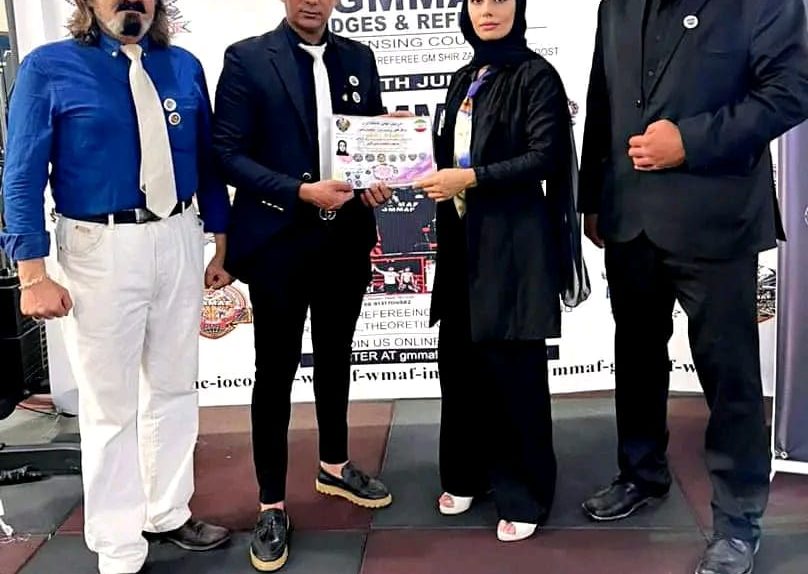
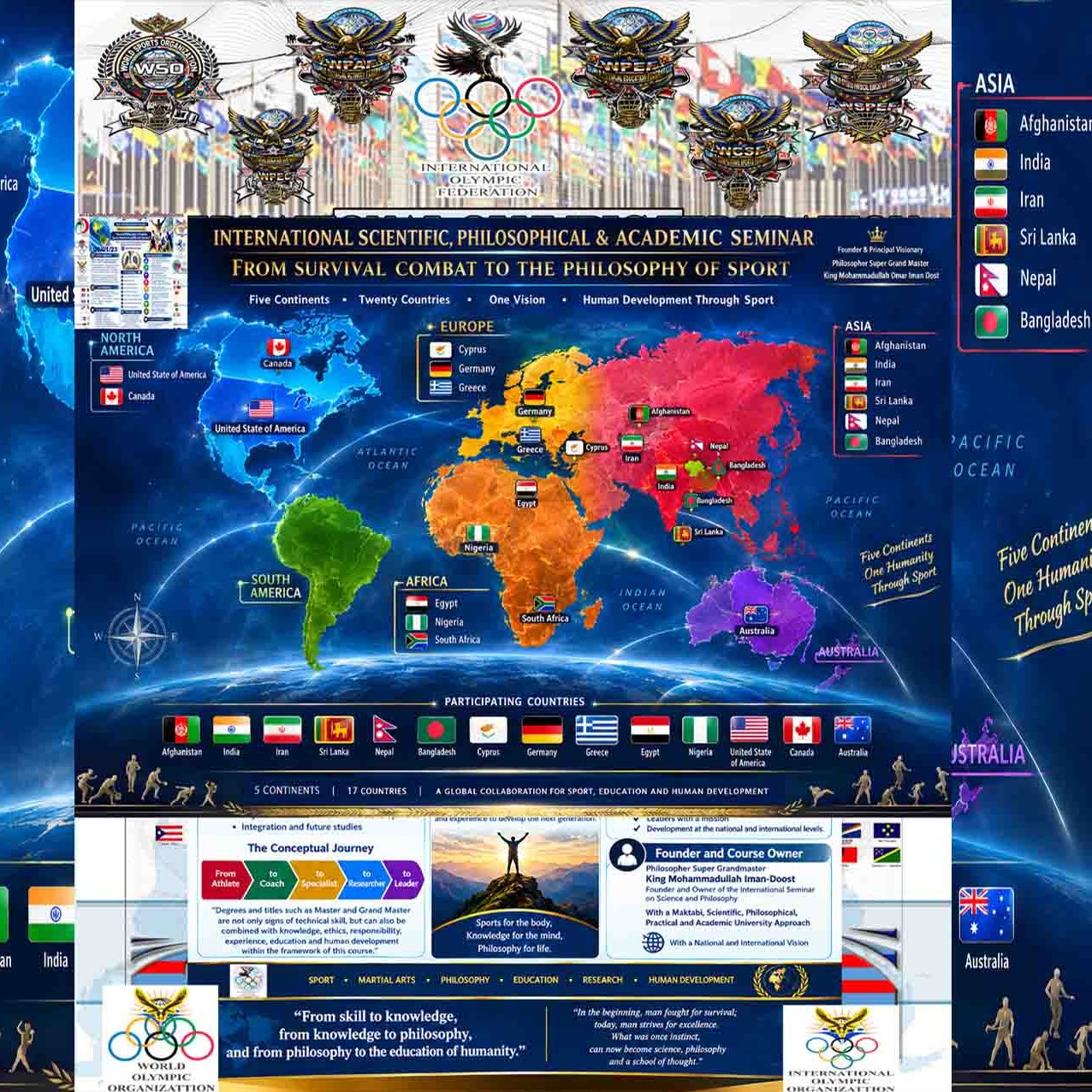
One published 2026 account also describes an international seminar organized by WNOF and an Afghanistan national non-Olympic sports federation, including a judges/referees licensing course.
Academic qualification of the description
For a scientific publication, it is important to distinguish between:
documented organizational claims
and
independently verified academic credentials.
Therefore, titles such as “Philosopher,” “Super Grandmaster,” “King of the World,” or similar designations should be presented as titles used by the organizations unless independent documentary evidence establishes their academic or legal status.
This does not prevent introducing him; it simply makes the research academically more rigorous.
14. A Scientific Model of the Global Sports System
The global system can be represented as follows:
HUMAN PHYSICAL ACTIVITY
↓
EXERCISE
↓
SPORT
↓
┌──────────────────────────────┐
│ │
OLYMPIC SPORTS NON-OLYMPIC SPORTS
│ │
Olympic Programme International / National
│ competitions
│ │
IOC Olympic system Non-Olympic federations
│ │
└──────────────┬───────────────┘
↓
GLOBAL SPORTS CULTURE
This model makes an important philosophical point:
The Olympic Games are a branch of the global sports tree, not the entire tree.
15. Example: Boxing
Boxing demonstrates why classification matters.
Boxing is:
- a sport;
- a combat sport;
- a regulated competitive discipline;
- governed internationally by a sporting federation;
- and an Olympic sport.
Therefore:
Boxing → Sport + Combat Sport + Olympic Sport
16. Example: Kickboxing
Kickboxing is:
- a sport;
- a combat sport;
- a martial/combat discipline;
- internationally organized.
But its Olympic status is different from boxing.
It has an international federation recognized by the IOC system, yet it is not currently an Olympic Games programme sport. Olympedia’s January 2026 list identifies kickboxing among sports whose international federation is IOC-recognized but whose sport was outside the Olympic programme.
Thus:
Kickboxing → Sport + Combat Sport + Non-Olympic Sport
17. Example: Chess
Chess demonstrates that “sport” is not limited to conventional physical competition.
Chess has:
- international competition;
- athletes/players;
- rankings;
- world championships;
- international federation;
- extensive scientific research concerning cognition and decision-making.
Yet it is not an Olympic Games sport.
Thus:
Chess → Competitive Sport / Mind Sport + Non-Olympic
It is also listed among sports with IOC-recognized international federations but outside the Olympic programme.
18. Philosophical Meaning
The deeper philosophical question is:
Who determines what counts as sport?
There are several layers:
Biological Level
The human body moves.
Psychological Level
The human being seeks challenge, achievement and mastery.
Social Level
Communities create rules and competitions.
Cultural Level
Societies preserve traditional physical activities.
Institutional Level
Organizations create federations and governance systems.
International Level
International bodies establish global structures.
Olympic Level
The IOC determines the sports and disciplines included in the Olympic Games programme.
Therefore, Olympism is one institutional expression of sport, while sport itself is a much broader human phenomenon.
19. The Philosophical Principle of WNOF
Within the philosophy attributed to the WNOF framework, the central idea can be summarized as:
“Sport should serve humanity, not humanity merely serve the institution of sport.”
This means that sport should contribute to:
- physical health;
- mental development;
- education;
- discipline;
- friendship;
- cultural exchange;
- peace;
- professional development;
- scientific knowledge.
From this perspective, Olympic and non-Olympic sports can coexist as different parts of a larger global sporting ecosystem.
20. Final Definition
Olympic Sport
A sport included in the official programme of the Olympic Games.
IOC-Recognized Non-Olympic Sport
A sport whose international federation is recognized within the IOC system but which is not currently included in the Olympic Games programme.
Non-Olympic Sport
A sport that is not included in the Olympic Games programme, whether or not its international federation is recognized by the IOC.
International Non-Olympic Federation
An international organization established to develop, administer, regulate, promote or coordinate one or more sports outside the Olympic programme, according to its own legal and organizational framework.
World Non-Olympic Federation
According to its published statutes, WNOF is an international non-profit, non-governmental organization intended to provide an international framework for non-Olympic sports and sporting organizations.
Conclusion
The most scientifically accurate conclusion is:
Not every sport is Olympic, but every Olympic sport is part of the larger world of sport.
The Olympic Games represent a highly structured international sporting programme, while the Non-Olympic Sports Movement encompasses a much broader range of sporting disciplines and organizations.
From a philosophical perspective, this diversity is important because human physical culture cannot be reduced to one competition or one institution.
Human beings run, fight, wrestle, swim, climb, think, cooperate, compete, create and teach.
Therefore:
Sport is larger than the Olympics.
And the scientific study of sport should consider the entire spectrum:
Physical Activity → Exercise → Sport → Martial Arts → Combat Sports → Olympic Sports → Non-Olympic Sports → Physical Education → Sports Science → Human Development.
In this broader framework, the World Non-Olympic Federation (WNOF) presents itself as an international institutional platform for non-Olympic sport, while Mohammadullah Omar Iman Dost is identified by WNOF’s own published materials as its founder and leader. These institutional claims should be distinguished from independently verified IOC recognition or independently verified academic credentials when the material is used in scholarly publications.