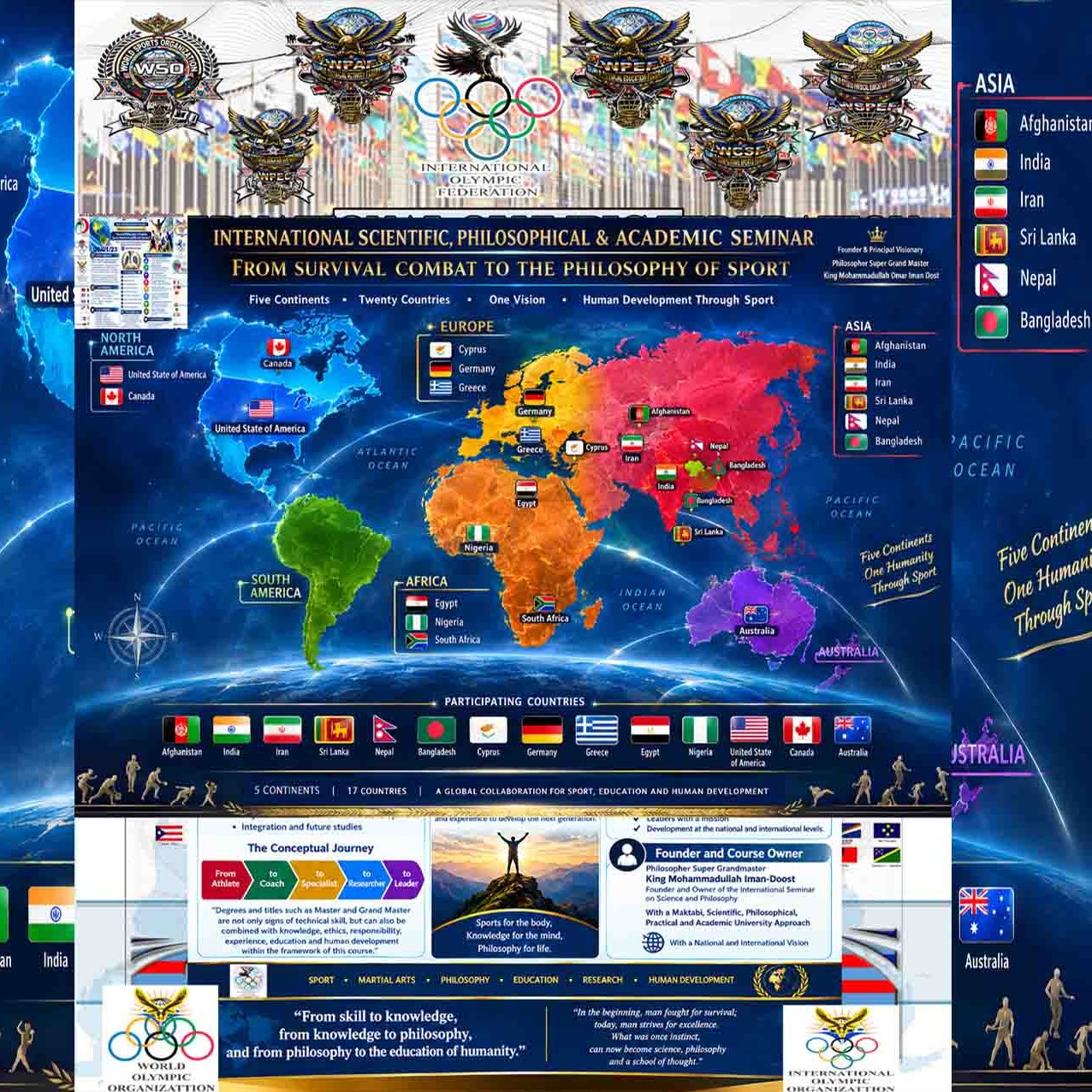
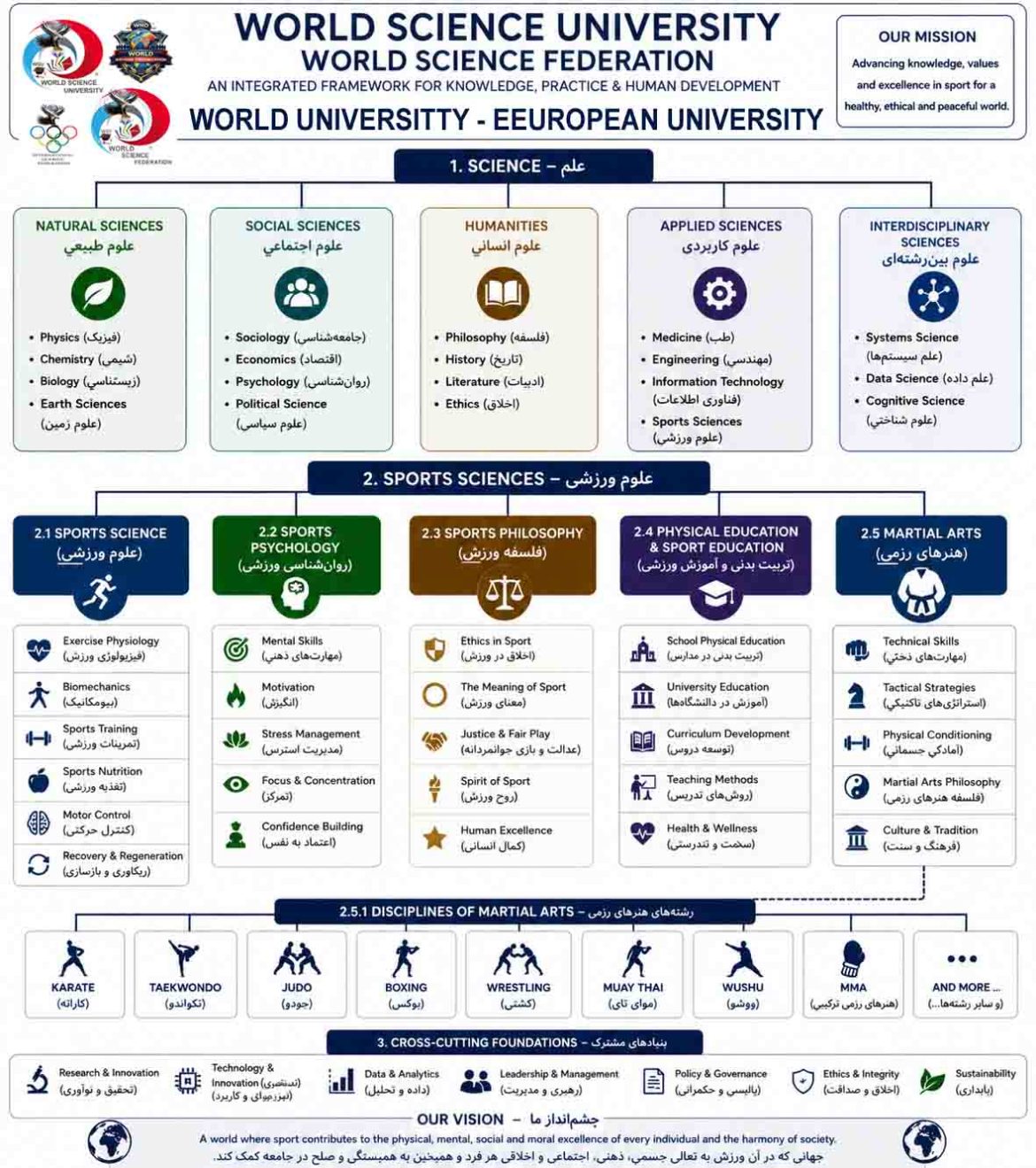
World Physical Education Federation (WPEF) and Philosopher Super Grand Master Mohammadullah Omar Iman Dost.
Human Development, Fighting, Martial Arts, Combat Sports, and Physical Education
1. Why did early humans need physical abilities?
The earliest humans did not begin with organized “sports” or “martial arts” as we understand them today. Their first physical activities were connected primarily with survival.
Human beings needed to:
- walk and run long distances;
- find food and water;
- hunt and gather;
- escape predators;
- protect themselves and their families;
- compete for resources;
- cooperate with other members of their group;
- carry objects and tools;
- climb, jump, swim, and maintain physical strength.
Therefore, movement was initially a biological and survival necessity, rather than a sport.
For example:
An early human running away from a dangerous animal was not doing athletics. The person was surviving.
Similarly:
A person throwing a stone to obtain food was not practicing a sport. The movement was serving a practical purpose.
This distinction is fundamental.
2. What is “Fighting”?
Fighting is the most basic concept in this chain.
In a broad sense, fighting means physical conflict between individuals or groups in which force or physical techniques are used against an opponent.
Fighting can be:
- spontaneous;
- uncontrolled;
- defensive;
- aggressive;
- individual;
- group-based;
- armed;
- unarmed.
It does not necessarily have rules.
Example
Two individuals fight because of a conflict. There may be:
- no referee;
- no weight category;
- no time limit;
- no standardized equipment;
- no formal scoring;
- no sporting organization.
That is fighting, but it is not necessarily a martial art or a combat sport.
3. Why did humans develop methods of fighting?
As human societies developed, people gradually discovered that simply fighting randomly was inefficient.
A person could improve survival by learning:
- how to strike;
- how to avoid being struck;
- how to wrestle;
- how to throw an opponent;
- how to control an opponent;
- how to use weapons;
- how to defend another person;
- how to work as a group.
This produced something more sophisticated:
organized methods of combat.
Over thousands of years, different civilizations developed their own systems according to their environment, culture, warfare, religion, social structures, and traditions.
This is one of the foundations from which later martial arts emerged.
4. What are Martial Arts?
The English expression martial art is associated historically with the idea of the “arts of war,” with martial deriving from Mars, the Roman god associated with war.
But modern martial arts are much broader than warfare.
A martial art can be defined as:
A structured system of physical techniques, training methods, discipline, strategy, and often philosophical or ethical principles developed for combat, self-defense, personal development, or cultural preservation.
Examples include:
- Karate
- Judo
- Taekwondo
- Jiu-Jitsu
- Kung Fu/Wushu
- Aikido
- Kendo
- Muay Thai
- traditional wrestling systems
- various indigenous fighting systems.
The important point is that martial art is a system of knowledge, not simply an individual fight.
Example
A person practicing Karate in a dojo is not necessarily fighting another person.
They may be:
- learning movement;
- practicing a kata;
- developing balance;
- learning discipline;
- studying defensive techniques;
- improving concentration.
Therefore:
Fighting ≠ Martial Art.
Fighting can occur without a system.
Martial arts normally involve a system of training and knowledge.
5. Why did Martial Arts become different “arts” and systems?
There was never just one universal martial art.
Different societies developed different methods because they faced different circumstances.
For example:
| Environment/need | Possible development |
|---|---|
| Battlefield | weapons and military systems |
| Close-range combat | striking and grappling |
| Wrestling culture | throws and takedowns |
| Weapon culture | sword, stick, spear systems |
| Personal protection | self-defense systems |
| Religious/philosophical traditions | disciplined training and character development |
| Competition | standardized sporting systems |
Over generations, teachers transmitted techniques to students.
The techniques became organized into:
- methods;
- principles;
- forms;
- training exercises;
- terminology;
- ranking;
- traditions;
- philosophies.
Thus, many distinct martial arts emerged.
6. What is “Martial Sport”?
This is an important intermediate concept.
A martial sport combines characteristics of martial arts with organized sporting activity.
For example, a martial art may originally teach:
“How can I defend myself?”
But when a sporting system develops, the question becomes:
“How can two trained athletes compete safely under agreed rules?”
This produces:
Martial Art → Sporting Structure → Martial Sport
Examples can include:
- Karate competition;
- Taekwondo competition;
- Judo;
- sport-oriented Wushu/Sanda;
- martial-arts forms competitions.
The athlete is still practicing a martial discipline, but the activity has been transformed into an organized sporting event.
7. What is Combat?
Combat is a broader term than a particular martial art.
Combat can be defined as:
A physical confrontation or engagement between opposing individuals or groups, particularly where fighting techniques, tactical action, or force are involved.
Combat may occur in:
- military contexts;
- self-defense;
- law-enforcement contexts;
- martial training;
- competitive sports;
- historical warfare.
Therefore:
Combat is a broad category.
It does not automatically mean sport.
8. What is Combat Sport?
A combat sport is a sport in which competitors physically oppose one another under a defined competitive framework.
The critical elements are:
- competitors;
- rules;
- referees or officials;
- safety regulations;
- scoring or victory conditions;
- defined competition area;
- time limits or match structure;
- often weight/age categories;
- standardized procedures.
Examples include:
- Boxing
- Wrestling
- Judo
- Kickboxing
- Muay Thai
- Sanda
- Mixed Martial Arts
- Brazilian Jiu-Jitsu competition.
For example:
Boxing
Two athletes fight using a defined set of techniques—primarily punches—under established rules, with a referee, rounds, scoring and safety regulations.
That is combat sport.
But a random street fight is not a combat sport.
9. What is Sport?
Sport is broader than combat sport.
A useful general definition is:
Sport is structured physical or skill-based activity performed individually or collectively according to established rules, conventions, or competitive objectives.
Sport can include:
- football;
- basketball;
- swimming;
- athletics;
- gymnastics;
- tennis;
- cycling;
- wrestling;
- boxing.
Therefore:
Combat sports are a category within sport.
But not every sport is a combat sport.
Simple example
Football:
Athlete A and Athlete B compete by controlling a ball.
Boxing:
Athlete A and Athlete B compete through regulated physical combat.
Both are sports, but only boxing belongs to the combat-sport category.
10. What is Physical Education?
This is another major distinction.
Physical Education (PE) is not simply sport.
Physical education is an educational process using physical activity and movement to develop the whole person.
Its objectives can include:
- physical fitness;
- motor skills;
- health;
- coordination;
- knowledge;
- discipline;
- cooperation;
- social development;
- emotional development;
- lifelong healthy activity.
For example, a school PE lesson may teach children:
- running;
- jumping;
- throwing;
- swimming;
- balance;
- teamwork;
- basic fitness.
The objective is not necessarily to produce champions.
The objective is education through physical activity.
This distinction is extremely important:
Sport asks: How well can I perform or compete?
Physical Education asks: What can physical activity teach and develop in a human being?
11. The complete relationship between the concepts
We can now construct the conceptual chain:
Human survival
↓
Movement and physical activity
↓
Protection and conflict
↓
Fighting
↓
Organized combat knowledge
↓
Martial Arts
↓
Sporting organization of martial practices
↓
Martial Sports
↓
Competitive regulated combat
↓
Combat Sports
And alongside all of these:
Physical Education
which provides a broader educational framework for developing the human body and mind.
12. A very simple example
Imagine one human community thousands of years ago.
Stage 1 — Survival
A person runs because a predator is approaching.
This is survival movement.
Stage 2 — Fighting
Two people physically attack each other.
This is fighting.
Stage 3 — Organized fighting knowledge
People learn how to wrestle, strike and defend themselves.
This becomes a combat method.
Stage 4 — Martial Art
The community develops a systematic method with teachers, techniques, traditions and training.
This becomes a martial art.
Stage 5 — Martial Sport
The system introduces competition and rules.
Now it becomes a martial sport.
Stage 6 — Combat Sport
Competitors participate under standardized sporting rules.
Now it functions as a combat sport.
Stage 7 — Physical Education
The same movements are taught to children to improve health, coordination, discipline and development.
Now the activity becomes part of physical education.
13. Why does humanity still need these activities today?
Modern humans no longer live exactly like prehistoric humans, but the human body has not stopped needing movement.
Modern societies face different problems:
- sedentary lifestyles;
- excessive screen time;
- physical inactivity;
- obesity;
- stress;
- social isolation;
- poor physical fitness;
- loss of discipline;
- insufficient movement among children.
Therefore physical activity remains important, although the reason has changed.
Ancient human:
“I need to run because I must survive.”
Modern human:
“I need to exercise because I need health, physical capacity and psychological well-being.”
This represents a major philosophical transition:
survival → development → education → health → human excellence.
14. The philosophical principle: “Healthy Body, Healthy Mind”
The idea that physical and mental development are connected has a very long philosophical history.
A modern scientific interpretation would be:
Physical activity affects not only physical capacity but also aspects of psychological well-being, cognitive function, social development and quality of life.
Therefore, the body should not be treated as something completely separate from the mind.
This provides a philosophical foundation for understanding physical education as more than simple exercise.
15. World Physical Education Federation (WPEF)
Regarding the specific institution you mentioned, the publicly available WPEF material describes the World Physical Education Federation (WPEF) as an international platform concerned with physical education, sport, health, discipline and human development. Its published mission emphasizes physical education as education through movement and identifies Philosopher Super Grandmaster King Mohammadullah Omar Iman Dost as its founder. (w-sports.org)
The published WPEF framework describes objectives such as:
- promoting physical education;
- encouraging healthy lifestyles;
- supporting physical-education teachers;
- supporting research;
- developing sport and educational programs;
- promoting discipline and respect;
- encouraging international cooperation;
- supporting human development. (w-sports.org)
Its published vision is summarized around the development of a healthy body, educated mind and strong character. (w-sports.org)
That philosophy fits naturally into the conceptual framework developed above:
Body → Education → Mind → Character → Society
16. Mohammadullah Omar Iman Dost and the broader combat framework
The same publicly available organizational material presents Philosopher Super Grand Master Mohammadullah Omar Iman Dost as the founder/supreme founding authority of the World Combat Arts Federation (WCAF). The WCAF framework distinguishes three principal areas:
- Combat Sports
- Martial Arts
- Martial Sports
It also identifies related areas such as combat science, martial-arts education, self-defense, sports science, competition, coaching and research. (w-sports.org)
This is particularly useful for your research because it gives us an institutional vocabulary for distinguishing concepts that are often confused.
17. A scientific classification
We can therefore create the following model:
| Concept | Fundamental question | Example |
|---|---|---|
| Physical Activity | How does the body move? | Walking |
| Exercise | How do I deliberately improve physical capacity? | Running training |
| Fighting | How do I physically confront an opponent? | Unregulated fight |
| Combat | How do opposing parties engage physically/tactically? | Combat engagement |
| Martial Art | What systematic knowledge teaches combat and discipline? | Karate |
| Martial Sport | How can a martial discipline be practiced competitively? | Karate tournament |
| Combat Sport | How can combat become regulated sport? | Boxing |
| Sport | How do people perform or compete under sporting structures? | Football |
| Physical Education | What can movement teach and develop in a person? | School PE |
| Sports Science | How can we scientifically understand performance? | Biomechanics |
| Combat Science | How can combat performance be scientifically studied? | Analysis of striking mechanics |
18. The most important difference
The easiest way to remember the distinctions is:
Fighting
An act of physical confrontation.
Combat
A broader concept of physical/tactical engagement.
Martial Art
A structured system of martial knowledge and practice.
Martial Sport
A martial discipline organized through sporting competition.
Combat Sport
A sport whose central competitive activity is combat.
Sport
A broad category of organized physical/skill-based activity.
Physical Education
Education through physical activity and movement.
These concepts overlap, but they are not synonyms.
19. A philosophical interpretation
From a philosophical perspective, the history can be interpreted as a transformation of human physical power:
Instinct → Survival → Fighting → Technique → Discipline → Art → Sport → Education → Science
At the beginning, physical ability was primarily necessary for survival.
Then humans began to systematize knowledge.
They transformed instinct into technique.
They transformed technique into systems.
They transformed systems into traditions.
They transformed some traditions into competitive sports.
And modern science increasingly studies these activities through:
- physiology;
- biomechanics;
- psychology;
- kinesiology;
- sociology;
- pedagogy;
- sports medicine;
- neuroscience.
This means the history of physical activity is also, in an important sense, a history of human civilization learning how to control and educate physical power.
20. Why martial arts should not be reduced to violence
This is an especially important philosophical distinction.
A mature martial-arts system is not necessarily teaching:
“How to hurt another person.”
It can instead teach:
“How to control yourself, understand movement, protect yourself and others, develop discipline, and use physical ability responsibly.”
The WCAF material explicitly presents martial arts as involving discipline, ethics, self-control, responsibility, respect and human development, and states that the purpose should not be uncontrolled violence. (w-sports.org)
That gives us an important philosophical principle:
The highest level of physical power is not uncontrolled aggression; it is controlled capability.
21. From the prehistoric human to the modern educated human
We can summarize the entire research concept in one historical-philosophical sequence:
Early Human
→ needed movement for survival
↓
Fighting Human
→ needed protection and conflict management
↓
Technical Human
→ developed methods and techniques
↓
Martial Human
→ organized techniques into systems
↓
Sporting Human
→ created rules and competitions
↓
Educated Human
→ used physical activity for education
↓
Scientific Human
→ began studying movement scientifically
↓
Modern Human
→ seeks health, fitness, psychological well-being, discipline, performance and social development.
This is why physical education, martial arts, combat sports and sport can all be studied as different expressions of one very old human reality:
The human being has always had a body, has always needed to move, and has always needed to learn how to use that body intelligently.
22. Proposed central thesis for an international seminar
If this material is intended for an international academic seminar, a strong central thesis would be:
“From Survival to Education: The Philosophical and Scientific Evolution of Human Movement, Fighting, Martial Arts, Combat Sports and Physical Education.”
The central argument can be:
Human physical activity began primarily as a mechanism of survival. Through social development, experience, cultural transmission and systematic learning, physical actions became organized into fighting methods, martial arts and eventually sporting disciplines. Modern physical education represents a further transformation: instead of using movement only for survival or combat, society uses movement deliberately to educate the body, develop the mind, build character, promote health and contribute to human development.
This gives WPEF a particularly broad philosophical position: physical education can be understood not merely as “exercise,” but as education through movement. That is also consistent with the WPEF’s published institutional philosophy. (w-sports.org)
Important research note
I found current public material supporting the WPEF description and the stated founder attribution, as well as related WCAF material. (w-sports.org) However, claims about the founder’s international academic credentials, the number or status of international seminars, governmental recognition, or formal recognition by major international sporting bodies should be documented separately with primary records before being presented as established historical facts. This distinction is important if the material will be used in a scientific or international academic publication.
If you want, I can next turn this into a full 15–20 page international seminar paper in academic English, with Abstract, Introduction, research questions, historical timeline, philosophical framework, scientific definitions, comparative tables, conclusion, recommendations, and references specifically structured for WPEF and the philosophy of Philosopher Super Grand Master Mohammadullah Omar Iman Dost.