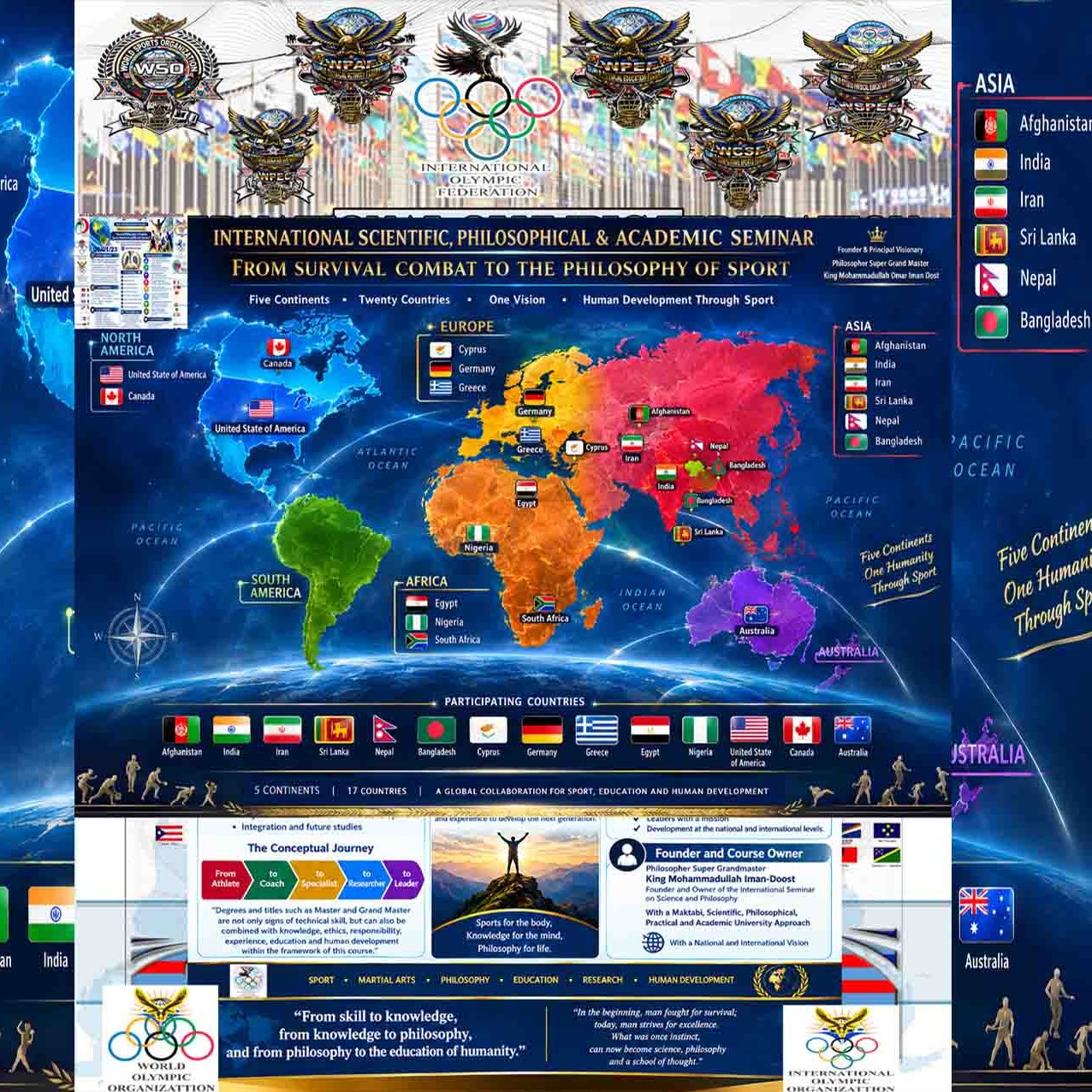
THE FIRST INTERNATIONAL ACADEMIC, SCIENTIFIC AND PHILOSOPHICAL SEMINAR ON THE COMPREHENSIVE SCIENCE OF SPORT
From Early Human Movement and Combat to Martial Arts, Combat Sports, Olympic and Non-Olympic Sports
An Academic, Scientific, Philosophical and Multidisciplinary Framework for the Study of Sport and Human Physical Development
Executive Statement
Sport is one of the oldest expressions of human physical, intellectual, social and cultural development.
Before sport became an organized institution, human beings moved for survival. They walked, ran, climbed, jumped, carried, threw, hunted, defended themselves and cooperated with others. Over the course of human civilization, these fundamental physical behaviors gradually developed into systematic forms of physical training, combat, martial arts, games, competitions, sports and, eventually, modern scientific physical education.
The present seminar was designed to study this historical and philosophical evolution as one interconnected field rather than examining sport exclusively through technique and tactics.
According to the organizers’ institutional account, this specialized seminar was conducted under the leadership and supervision of the relevant participating sports and physical-education organizations and involved approximately 50 participants representing five continents.
The programme extended over approximately three months, with three classes/conference sessions per week, and combined theoretical, practical, analytical, scientific and philosophical study.
Its central purpose was to examine sport as a multidisciplinary human science:
From the human body as an instrument of survival to the human body as an instrument of education, health, scientific performance, culture and human development.
1. The Central Academic Thesis
The central thesis of the seminar is:
Sport did not suddenly appear as a modern institution. It evolved progressively from fundamental human movement, survival activities and physical confrontation into organized systems of training, martial arts, competitive combat, games, sports, physical education and modern sports science.
This evolution may be represented as:
Human Movement
↓
Survival Activity
↓
Physical Competition and Fighting
↓
Organized Combat
↓
Martial Arts
↓
Martial Sports
↓
Combat Sports
↓
Sport
↓
Olympic and Non-Olympic Sports
↓
Physical Education
↓
Sports Science
↓
Modern Human Development
This model provides the philosophical foundation of the seminar.
2. Human Movement Before Sport
The earliest human physical activities were not sports in the modern institutional sense.
They were associated with:
- survival;
- hunting;
- gathering;
- escaping danger;
- protecting families;
- carrying resources;
- travelling;
- climbing;
- throwing;
- swimming;
- running;
- jumping.
The human body was initially a biological instrument of survival.
A person who ran from a predator was not an athlete.
A person who threw a stone while hunting was not a competitive thrower.
A person who wrestled another person over a resource was not participating in a regulated wrestling tournament.
However, these activities created the physical and neurological foundations from which later forms of human physical culture developed.
Thus:
Before humanity created sport, humanity already possessed movement.
3. From Movement to Fighting
As human communities developed, physical confrontation became another dimension of human existence.
Fighting could occur for:
- protection;
- territory;
- resources;
- social conflict;
- defence;
- warfare;
- survival.
Early fighting was generally not governed by modern sporting rules.
There were normally no standardized:
- weight categories;
- rounds;
- referees;
- scoring systems;
- protective equipment;
- competition regulations.
Therefore:
Fighting is not automatically a sport.
Fighting is fundamentally an act or process of physical confrontation.
4. From Fighting to Organized Combat
Human beings gradually learned that physical confrontation could be improved through knowledge.
Techniques were observed, practiced, transmitted and refined.
Communities developed knowledge concerning:
- striking;
- grappling;
- throwing;
- blocking;
- evasion;
- balance;
- weapons;
- distance;
- timing;
- strategy;
- physical conditioning.
This represented a major transformation:
Instinctive physical confrontation became organized physical knowledge.
This is one of the foundations of martial traditions.
5. The Emergence of Martial Arts
Martial arts developed through the systematic organization and transmission of combat knowledge.
A martial art can contain:
- technical knowledge;
- training methodology;
- strategy;
- discipline;
- tradition;
- philosophy;
- ethics;
- physical conditioning;
- cultural identity.
The transformation can therefore be described as:
Fighting → Technique → System → Tradition → Martial Art
The martial artist is not simply someone who fights.
The martial artist studies a system.
This distinction is fundamental to the seminar’s academic framework.
6. From Martial Arts to Martial Sports
When a martial-art system becomes organized for structured competition, another transformation occurs.
The emphasis shifts partly from:
“How do I survive or defend myself?”
toward:
“How do trained practitioners compete under agreed rules?”
This introduces:
- referees;
- scoring;
- competition categories;
- safety regulations;
- time limits;
- competition areas;
- standardized procedures.
Thus:
Martial Art + Rules + Competition = Martial Sport
7. The Emergence of Combat Sports
Combat sports represent a specialized category of sport in which physical confrontation forms the central competitive activity.
Examples include:
- Boxing;
- Wrestling;
- Judo;
- Taekwondo;
- Kickboxing;
- Muay Thai;
- Sanda;
- Brazilian Jiu-Jitsu competition;
- Mixed Martial Arts.
A combat sport is therefore not simply “fighting.”
It is:
regulated competitive physical confrontation governed by an established sporting framework.
The distinction between fighting and combat sport is consequently essential:
Street fight → Fighting
Regulated boxing match → Combat Sport
8. Sport as a Larger Human Institution
Sport is broader than combat.
Sport encompasses activities involving:
- physical performance;
- skill;
- competition;
- recreation;
- teamwork;
- strategy;
- discipline;
- achievement.
Examples include:
- athletics;
- swimming;
- football;
- basketball;
- volleyball;
- cycling;
- gymnastics;
- tennis;
- rowing;
- martial arts;
- combat sports.
Consequently:
Combat sports are a category of sport, but sport is not limited to combat.
9. Olympic and Non-Olympic Sports
A central component of the seminar was the comparative study of Olympic and non-Olympic sport.
Olympic Sports
An Olympic sport is a sport included in the official programme of the Olympic Games.
Non-Olympic Sports
A non-Olympic sport is a sport that is not currently included in the Olympic Games programme.
The seminar recognizes an important scientific distinction:
Olympic status is an institutional classification; it is not a scientific measurement of the intrinsic value of a sport.
A non-Olympic sport may possess:
- international federations;
- world championships;
- national federations;
- professional athletes;
- scientific research;
- coaching systems;
- technical regulations;
- international competitions.
Therefore:
Non-Olympic does not mean non-sport.
10. The Multidisciplinary Scientific Structure of the Seminar
One of the defining features of this seminar, according to the organizers’ account, was its attempt to examine sport beyond technique and tactics.
The programme incorporated scientific fields including:
Exercise Physiology
Study of:
- cardiovascular responses;
- respiratory responses;
- energy systems;
- muscular adaptation;
- endurance;
- recovery;
- physical conditioning.
Physiotherapy
Study of:
- injury prevention;
- rehabilitation;
- movement dysfunction;
- recovery;
- musculoskeletal function;
- safe return to activity.
Biomechanics
Study of:
- force;
- movement;
- acceleration;
- balance;
- joint mechanics;
- body alignment;
- center of mass;
- kinetic and kinematic principles.
Psychology
Study of:
- concentration;
- motivation;
- stress;
- confidence;
- emotional regulation;
- performance psychology.
Pedagogy
Study of:
- teaching;
- learning;
- coaching;
- curriculum;
- physical education;
- educational development.
Sports Sociology
Study of:
- sport and society;
- culture;
- identity;
- international cooperation;
- inclusion;
- social development.
Sports Philosophy
Study of fundamental questions:
- What is sport?
- Why does humanity compete?
- What is the relationship between body and mind?
- What is fair competition?
- What is discipline?
- What is excellence?
- What is the ethical purpose of physical power?
11. Theory and Practice
The seminar deliberately combined:
Theory + Practice
Scientific knowledge without practical application can remain abstract.
Practical experience without scientific analysis can remain incomplete.
Therefore, the seminar adopted an integrated approach:
Scientific Theory
Practical Application
Observation
Analysis
Discussion
Evaluation
=
Integrated Sports Knowledge
The practical dimension included examination of:
- technique;
- tactics;
- physical conditioning;
- movement;
- combat applications;
- sport-specific performance.
The theoretical dimension included:
- physiology;
- biomechanics;
- physiotherapy;
- psychology;
- pedagogy;
- philosophy;
- sports science.
12. Academic Examination System
The seminar also incorporated a structured examination process.
According to the organizers’ description, participants were assessed through a four-option multiple-choice examination system.
This model was intended to evaluate participants’ understanding of the subjects studied throughout the programme.
The examination format can assess:
- conceptual knowledge;
- scientific understanding;
- terminology;
- analytical comprehension;
- historical knowledge;
- philosophical concepts;
- sports classification.
However, for future academic development, multiple-choice examination should ideally be supplemented with:
- written research papers;
- oral examinations;
- practical assessments;
- case studies;
- presentations;
- scientific projects.
This would create a more comprehensive assessment model.
13. International Dimension
The seminar is described by its organizers as an international academic initiative involving approximately:
50 participants representing five continents.
The international dimension is important because sport is inherently global.
Different countries possess different:
- sporting cultures;
- martial traditions;
- educational systems;
- coaching philosophies;
- competition structures.
An international seminar creates an opportunity for:
Comparison → Dialogue → Research → Cooperation → Knowledge Exchange
The purpose is not to eliminate cultural differences but to transform them into opportunities for academic learning.
14. The Philosophical Foundation
The seminar’s philosophical foundation can be summarized in one principle:
The human body is not merely an instrument for competition; it is an essential dimension of human existence, education and development.
This leads to the classical relationship:
Healthy Body
↓
Healthy Mind
↓
Disciplined Character
↓
Responsible Human Being
↓
Healthy Society
From this perspective, sport is not merely about medals.
It can become a means of:
- education;
- health;
- self-knowledge;
- discipline;
- social cooperation;
- cultural exchange;
- personal excellence.
15. Sport as a Philosophy of Human Development
The seminar therefore approaches sport through five dimensions:
1. Biological
The body must function effectively.
2. Psychological
The mind must develop concentration and emotional regulation.
3. Technical
The individual must acquire physical skills.
4. Social
The individual must learn cooperation, respect and responsibility.
5. Philosophical
The individual must understand the meaning and purpose of physical development.
This produces a comprehensive model:
Body + Mind + Skill + Character + Knowledge = Human Development
16. Beyond Technique and Tactics
A central principle of the seminar is that sport education must not be reduced to:
Technique + Tactics
These are essential, but incomplete.
A complete academic sports curriculum should also consider:
Technique
Tactics
Physiology
Biomechanics
Physiotherapy
Psychology
Pedagogy
Philosophy
Ethics
History
Sociology
Sports Management
Research Methodology
This represents a transition:
From the athlete as performer to the athlete as a complete human being.
17. The Seminar’s Claimed Historical Significance
According to the organizers’ institutional account, this programme was intended as a pioneering academic initiative that brought together, within one integrated seminar, the historical evolution of human movement, fighting, martial arts, combat sports, Olympic sports and non-Olympic sports together with physiology, physiotherapy, biomechanics and sports philosophy.
The organizers describe it as a first-of-its-kind academic and philosophical seminar of this comprehensive scope.
For scholarly publications, the strongest formulation is:
“The organizers identify the seminar as a pioneering and, to their knowledge, unprecedented comprehensive academic and philosophical programme integrating the historical evolution of human movement and combat with modern sports science and the study of Olympic and non-Olympic sport.”
This wording preserves the significance of the achievement while avoiding an absolute historical claim that would require a systematic review of all comparable seminars worldwide.
18. Institutional Leadership and Founder
According to the organizers’ institutional account, the seminar was developed under the leadership and founding vision of:
Philosopher Super Grand Master Mohammadullah Omar Iman Dost
The organizational materials associated with him present him as a:
- researcher;
- philosopher;
- martial-arts master;
- sports educator;
- sports organizer;
- founder of international sports organizations.
The same organizational materials associate him with the development of international initiatives involving:
- physical education;
- martial arts;
- combat sports;
- Olympic and non-Olympic sports;
- sports science;
- sports philosophy;
- international sports cooperation.
For academic accuracy, however, his titles and institutional roles should be documented through the relevant constitutions, certificates, registration documents, official appointment records and independent sources when this material is submitted to universities, governments or international academic bodies.
19. Institutional Recognition
The seminar is described by its organizers as having been conducted with the involvement, leadership, supervision or representation of organizations associated with:
- physical education;
- Olympic sport;
- world sport;
- international sport;
- non-Olympic sport.
For formal academic recognition, however, the precise legal and institutional status of every participating organization should be stated separately.
The following concepts should never be treated as identical:
Organizational Participation
≠
Institutional Partnership
≠
Accreditation
≠
Government Recognition
≠
IOC Recognition
≠
University Accreditation
This distinction is essential to maintaining academic integrity.
20. A Proposed International Academic Standard
The seminar can serve as a foundation for developing a standardized international programme entitled:
International Academic Science of Sport Seminar — IASS
Such a programme could contain:
Module 1
Human Evolution and Physical Activity
Module 2
History and Philosophy of Fighting
Module 3
History and Philosophy of Martial Arts
Module 4
Martial Sports
Module 5
Combat Sports
Module 6
Olympic Sports
Module 7
Non-Olympic Sports
Module 8
Exercise Physiology
Module 9
Biomechanics
Module 10
Physiotherapy and Injury Prevention
Module 11
Sports Psychology
Module 12
Sports Pedagogy
Module 13
Sports Ethics and Philosophy
Module 14
Sports Management and Governance
Module 15
Research Methodology
Module 16
Practical and Theoretical Examination
21. Proposed Academic Certification Model
A future international version could establish three levels:
Level I — Foundation
Introduction to:
- sport;
- physical education;
- martial arts;
- combat sports;
- Olympic and non-Olympic sport.
Level II — Professional
Advanced study of:
- physiology;
- biomechanics;
- psychology;
- physiotherapy;
- coaching;
- sports pedagogy.
Level III — Research
Research-oriented study involving:
- methodology;
- academic writing;
- data analysis;
- scientific presentation;
- independent research;
- philosophical analysis.
This would allow participants to progress from:
Student → Practitioner → Professional → Researcher
22. Proposed International Research Philosophy
The central research philosophy can be expressed as:
“Study the body scientifically, understand movement intelligently, practice sport responsibly, and develop the human being holistically.”
Another concise formulation is:
“From Physical Power to Scientific Knowledge; From Scientific Knowledge to Human Development.”
23. A Proposed Institutional Mission Statement
The mission of the programme can be expressed as follows:
To establish an international academic and multidisciplinary platform for the scientific, philosophical, historical and practical study of human physical activity, martial arts, combat sports, Olympic sports and non-Olympic sports, while integrating sports science, physiology, biomechanics, physiotherapy, psychology, pedagogy and ethics for the advancement of human health, education, performance and character.
24. A Proposed Vision Statement
To contribute to the development of a global culture in which sport is understood not merely as competition, but as a scientific, educational, philosophical and human institution.
25. Final Philosophical Conclusion
The history of sport can be understood as the history of humanity learning how to use the body more intelligently.
The sequence begins with:
Movement for Survival
and develops toward:
Movement for Development
Then:
Development through Education
And ultimately:
Scientific Understanding of Human Movement
Therefore, the ultimate purpose of the seminar is not simply to ask:
“Who is the strongest athlete?”
but to ask the deeper questions:
What is the human body?
Why does humanity move?
Why does humanity fight?
Why does humanity compete?
Why does humanity create rules?
Why does humanity create sport?
How can science improve physical performance without losing human values?
How can physical power be transformed into discipline, education and social responsibility?
These questions transform sport from a simple physical activity into a field of interdisciplinary academic inquiry.
26. The Central Formula
The complete philosophy of the seminar can therefore be represented as:
HUMANITY
↓
MOVEMENT
↓
SURVIVAL
↓
FIGHTING
↓
COMBAT
↓
MARTIAL ARTS
↓
MARTIAL SPORTS
↓
COMBAT SPORTS
↓
SPORT
↓
OLYMPIC + NON-OLYMPIC SPORTS
↓
PHYSICAL EDUCATION
↓
SPORTS SCIENCE
↓
PHILOSOPHY
↓
HUMAN DEVELOPMENT
Final Institutional Declaration
According to the organizers’ account, the seminar represents a major step toward establishing a comprehensive academic approach to sport in which historical, philosophical, scientific, practical and educational dimensions are studied together.
Its significance lies not merely in teaching athletes how to perform, but in creating a framework for understanding why humans move, fight, train, compete, learn and develop through sport.
The programme therefore proposes a broader conception of sport:
Sport is not only competition. Sport is movement, education, science, philosophy, culture, discipline and human development.
And the fundamental educational principle is:
A healthy body provides the foundation; an educated mind provides direction; disciplined character provides purpose.
In this philosophical framework, the work associated by the organizers with Philosopher Super Grand Master Mohammadullah Omar Iman Dost can be presented as an institutional effort to develop an integrated international approach to physical education, martial arts, combat sports, Olympic and non-Olympic sport, and sports science.
For future international recognition, the strongest path is to preserve complete documentary evidence of the seminar—including the official programme, participant register, five-continent representation, attendance records, lecture materials, examination papers, certificates, photographs/videos, organizational statutes, faculty credentials, independent academic reviewers and published proceedings—so that the historical and academic significance of the programme can be independently evaluated and documented.