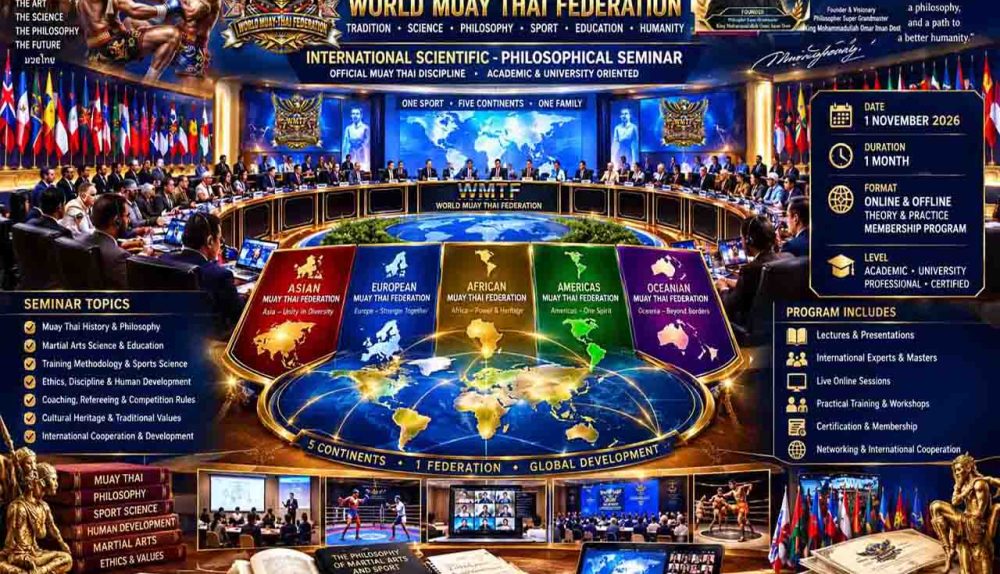
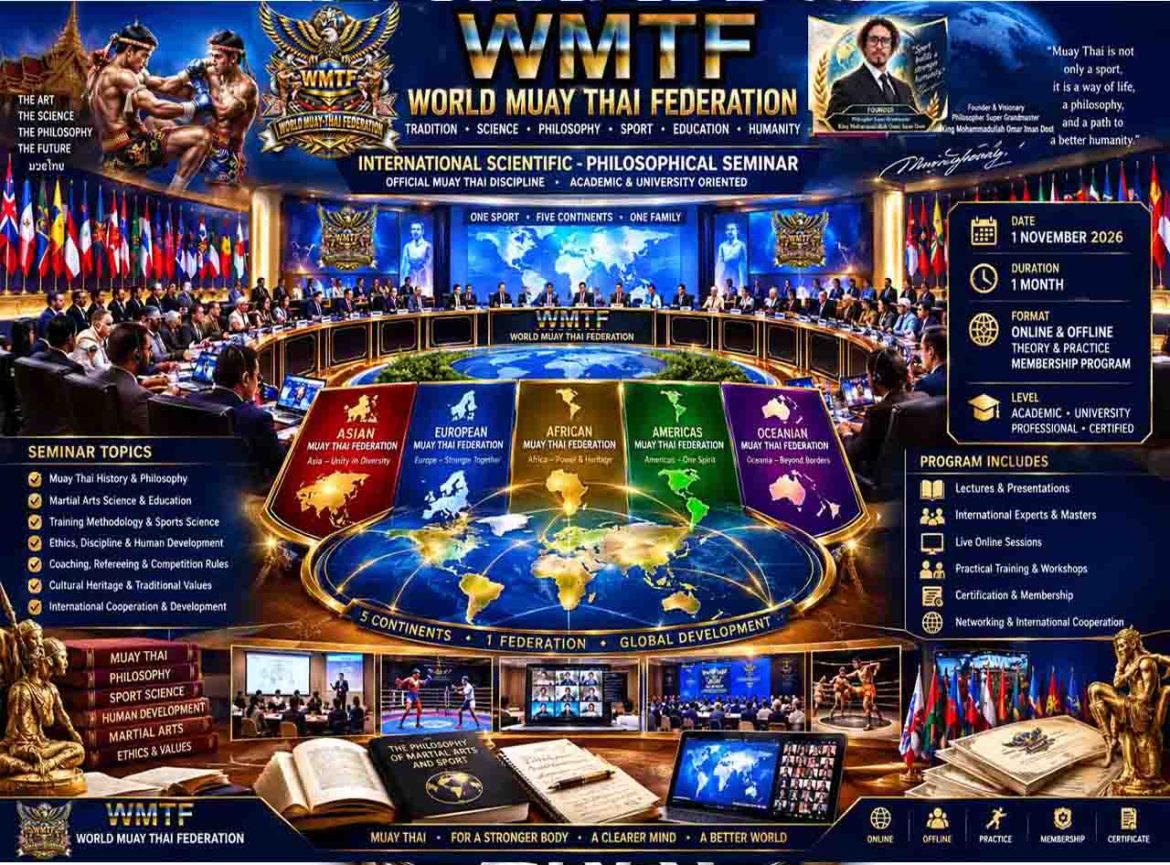
WORLD MUAY THAI FEDERATION (WMTF)
CONSTITUTION AND STATUTES
Founding document for international governance, development, competition, education and the protection of Muay Thai
Proposed Founder: Philosopher Super Grandmaster King Mohammadullah Omar Iman Dost
Proposed Honorary Title: Superman Masterking
Proposed Headquarters: To be determined in the country of legal registration.
Legal Status: Proposed international non-profit sports federation, subject to registration and applicable law.
Document Version: 1.0 — 2026
PREAMBLE
The World Muay Thai Federation (WMTF) is proposed as an international sports organization dedicated to the development, preservation, regulation and responsible promotion of Muay Thai.
Recognizing Muay Thai as a martial art, combat sport, cultural tradition and discipline requiring technical knowledge, physical conditioning, respect and self-control, the Federation seeks to establish a transparent framework for athletes, coaches, referees, clubs, national associations, event organizers and other qualified stakeholders.
The Federation shall respect the cultural heritage of Thailand, the historical traditions of Muay Thai, the dignity of its practitioners and the legitimate authority of existing sports organizations.
The Federation shall promote safe competition, ethical conduct, fair opportunity, international cooperation, athlete education and the sustainable development of Muay Thai.
The proposed founding initiative is associated with Philosopher Super Grandmaster King Mohammadullah Omar Iman Dost, with the proposed honorary title Superman Masterking, subject to the founding records and legal requirements applicable to the registered organization.
The Federation shall operate according to this Constitution, its duly adopted regulations and the laws governing its activities.
CHAPTER I — NAME, IDENTITY AND LEGAL STATUS
Article 1 — Official Name
- The official proposed name of the organization shall be the World Muay Thai Federation.
- Its proposed abbreviation shall be WMTF.
- The official name in other languages may be adopted by the competent governing body.
- The name, abbreviation, emblem and associated branding shall be used subject to trademark availability, applicable law and the rights of other organizations.
- Before registration, the founders shall verify that the proposed name is legally available and sufficiently distinguishable from existing sports organizations.
Article 2 — Founder and Founding Declaration
- The proposed founder is Philosopher Super Grandmaster King Mohammadullah Omar Iman Dost.
- The founder’s name shall be included in the founding declaration and historical records in accordance with the actual founding documents.
- The honorary title Superman Masterking may be used in ceremonial and historical references where legally permissible.
- The founder’s authority, if any, shall be defined by this Constitution, the founding resolution and applicable law.
- No honorary title shall automatically confer a government office, professional qualification, sporting credential or authority over an independent organization.
Article 3 — Legal Personality
- The Federation shall seek registration as a non-profit legal entity in a jurisdiction selected by the founders.
- Upon registration, it may acquire property, enter into contracts, open lawful financial accounts, employ personnel and undertake authorized activities.
- The Federation shall maintain records sufficient to demonstrate its legal status, governance and financial accountability.
- Its international character shall not exempt it from applicable national laws.
Article 4 — Headquarters and Territorial Scope
- The registered headquarters shall be determined by the founding members and approved in accordance with applicable law.
- The Federation may establish regional offices, national representatives, liaison offices and affiliated entities where legally permitted.
- International operations shall be conducted in accordance with local laws, relevant sporting regulations and valid agreements.
- The Federation shall not establish a national chapter or claim representation in a country without following the applicable membership and legal procedures.
Article 5 — Official Languages
- English shall be the principal proposed administrative language.
- Thai shall be recognized as an important language for cultural and technical engagement concerning Muay Thai.
- The Federation may adopt Persian, Arabic, French, Spanish and other languages for international accessibility.
- Official translations shall be reviewed for accuracy.
- The controlling legal version of the Constitution shall be identified in the registration documents.
CHAPTER II — VISION, MISSION AND OBJECTIVES
Article 6 — Vision
To promote Muay Thai as a respected international martial art and combat sport through fair competition, technical excellence, cultural preservation, athlete welfare and responsible international cooperation.
Article 7 — Mission
The Federation shall:
- Develop and administer Muay Thai activities within its lawful jurisdiction.
- Establish transparent competition and officiating standards.
- Support the education of athletes, coaches, referees and technical officials.
- Promote safe training and medically responsible competition.
- Preserve the cultural and historical heritage of Muay Thai.
- Support national associations, clubs and community programs.
- Promote equal opportunity and responsible youth development.
- Facilitate international competitions and athlete exchanges.
- Encourage research, sports science and professional development.
- Cooperate with established sporting bodies through valid agreements.
Article 8 — Fundamental Principles
The Federation shall uphold:
- Respect for athletes, opponents, officials and cultural traditions.
- Fair play and sporting integrity.
- Safety and evidence-informed risk management.
- Transparency and accountability.
- Non-discrimination and equal opportunity.
- Independence of technical and disciplinary decisions.
- Responsible financial management.
- Protection of children and vulnerable persons.
- Respect for intellectual property and organizational autonomy.
- Compliance with applicable law.
Article 9 — Core Functions
The Federation may:
- Develop competition rules and technical standards.
- Organize or sanction authorized tournaments.
- Establish national and international ranking systems within its own competitions.
- Provide education and certification within its actual competence.
- Establish athlete-support and development programs.
- Maintain competition records and official statistics.
- Develop referee and coaching education.
- Promote cultural events and educational programs.
- Enter into lawful sponsorship and broadcasting agreements.
- Establish procedures for complaints, appeals and dispute resolution.
Article 10 — Limits of Authority
- The Federation’s authority shall extend only to activities and members within its lawful jurisdiction.
- It shall not automatically possess exclusive authority over Muay Thai worldwide merely by adopting this Constitution.
- It shall not claim recognition by the International Olympic Committee, an established international Muay Thai body, a national government or another federation without verifiable authorization.
- Existing organizations’ rules and intellectual property shall be respected.
- Any recognition, affiliation or delegation of authority shall be established by valid written evidence.
CHAPTER III — ORGANIZATIONAL STRUCTURE
Article 11 — Governing Organs
The principal organs of the Federation shall be:
- The General Assembly.
- The Board of Directors.
- The President.
- The Secretary-General.
- The Executive Committee.
- The Technical and Rules Council.
- The Refereeing and Judging Committee.
- The Medical and Athlete Safety Committee.
- The Ethics and Disciplinary Committee.
- The Independent Audit and Finance Committee.
- The Electoral Committee.
- The Dispute Resolution and Appeals Committee.
- The Athletes’ Commission.
- The Coaches’ Commission.
- The National and Regional Development Committees.
- Other specialized committees established in accordance with this Constitution.
Article 12 — General Assembly
- The General Assembly shall be the highest decision-making organ of the Federation.
- It shall consist of representatives of eligible voting members as defined in the membership regulations.
- Each voting member’s voting rights shall be clearly specified.
- The General Assembly shall elect the Board, approve constitutional amendments, review financial reports and exercise the powers assigned to it by this Constitution.
- An ordinary meeting shall be held at least once per year unless applicable law requires otherwise.
- An extraordinary meeting may be convened by the Board or upon a qualifying request from voting members.
- Notice, agenda items and supporting documents shall be distributed within the prescribed period.
- Meeting minutes and resolutions shall be recorded and retained.
Article 13 — Board of Directors
- The Board shall provide strategic leadership and oversee the Federation’s administration.
- The proposed Board shall comprise between seven and fifteen members.
- The General Assembly shall determine the exact number and election procedure.
- The proposed term shall be four years, subject to applicable law and the adopted electoral regulations.
- The Board should reflect appropriate professional, geographic and gender diversity.
- Board members shall disclose conflicts of interest.
- The Board shall not interfere improperly with independent disciplinary, electoral or medical decisions.
- Board members shall act in the Federation’s best interests and remain accountable to the General Assembly.
Article 14 — President
The President shall:
- Represent the Federation within the authority legally granted.
- Chair meetings as prescribed.
- Lead implementation of approved strategy.
- Coordinate with the Secretary-General.
- Report on institutional performance.
- Promote international cooperation.
- Refrain from exercising powers reserved to the General Assembly or independent committees.
Article 15 — Secretary-General
The Secretary-General shall oversee:
- Daily administration.
- Official correspondence and records.
- Staff and operational coordination.
- Implementation of resolutions.
- Membership records.
- Meeting preparation and minutes.
- Administrative reporting.
- Coordination of international communications.
Article 16 — Executive Committee
The Executive Committee shall implement approved policies, coordinate events, supervise operational plans and manage delegated administrative responsibilities.
Its authority shall be limited by the Board’s decisions, this Constitution and applicable law.
Article 17 — Independence and Conflicts of Interest
- Officials shall act impartially and disclose relevant financial or personal interests.
- Persons with material conflicts shall abstain from affected decisions.
- No officer shall improperly use the Federation’s name, funds, information or authority for personal benefit.
- Procurement, appointments, selection decisions and major contracts shall follow documented procedures.
- Retaliation against good-faith whistleblowers shall be prohibited.
CHAPTER IV — SPECIALIZED COMMITTEES
Article 18 — General Committee Framework
Each committee shall operate under a written mandate defining its responsibilities, membership, appointment procedure, budget, reporting obligations and term of service.
Committee membership shall be based on relevant qualifications, experience, integrity and appropriate representation.
Article 19 — Technical and Rules Committee
Responsible for:
- Drafting and updating technical competition rules.
- Defining authorized competition formats.
- Establishing equipment standards.
- Reviewing scoring systems.
- Developing technical guidance for event organizers.
- Recommending rule changes based on evidence and experience.
Article 20 — Refereeing and Judging Committee
Responsible for:
- Training and evaluating referees and judges.
- Establishing officiating qualification levels.
- Maintaining records of approved officials.
- Promoting consistent scoring and impartial decisions.
- Developing referee education and refresher courses.
- Reviewing officiating complaints through an impartial process.
- Maintaining separation between event promotion and technical decision-making.
Article 21 — Medical and Athlete Safety Committee
Responsible for:
- Developing medical safety standards.
- Establishing minimum medical coverage for events.
- Recommending pre-competition medical requirements.
- Establishing concussion and suspected head-injury procedures.
- Recommending appropriate recovery and return-to-training protocols.
- Advising on emergency planning.
- Supporting injury surveillance and prevention.
- Maintaining medical confidentiality.
Article 22 — Anti-Doping and Clean Sport Committee
Responsible for promoting clean competition and cooperating with competent anti-doping authorities.
Where anti-doping rules apply, the Federation shall use the relevant authorized framework, qualified personnel and due-process procedures. It shall not invent independent testing or sanctions that conflict with binding rules.
Article 23 — Athletes’ Commission
The Commission shall represent athlete interests and advise on:
- Competition conditions.
- Athlete contracts and rights.
- Training and travel arrangements.
- Safety and welfare.
- Fair selection procedures.
- Complaint mechanisms.
- Career development and post-competition opportunities.
Athlete representatives shall be selected through a transparent process.
Article 24 — Coaches and Technical Education Committee
Responsible for developing curricula for coaching, conditioning, technique, training planning, ethics, safeguarding and injury prevention.
Any qualification issued shall accurately describe its level and shall not be represented as a government license or universally recognized credential unless authorized.
Article 25 — National Federations and Membership Committee
Responsible for:
- Assessing membership applications.
- Maintaining a register of members.
- Supporting governance development.
- Advising on national development plans.
- Monitoring compliance with membership obligations.
- Recommending suspension or reinstatement where justified.
- Providing a fair review process for disputed membership decisions.
Article 26 — Championships and Events Committee
Responsible for:
- Preparing the competition calendar.
- Establishing host selection criteria.
- Coordinating registration and weigh-ins.
- Ensuring event plans include appropriate safety arrangements.
- Monitoring event delivery.
- Reviewing complaints and operational reports.
- Evaluating the quality and integrity of sanctioned competitions.
Article 27 — Professional Muay Thai Committee
Responsible for professional competition formats, contracts, event standards, athlete eligibility, purse transparency and coordination with licensed promoters.
Professional events shall comply with the relevant laws and regulatory requirements governing combat sports.
Article 28 — Amateur and Developmental Muay Thai Committee
Responsible for introductory and amateur competitions, technical development, age-appropriate formats and progression pathways.
Youth competition shall apply stricter safeguards and shall not automatically follow adult professional rules.
Article 29 — Traditional Muay Thai and Cultural Heritage Committee
Responsible for:
- Documenting the history and traditions of Muay Thai.
- Promoting culturally respectful education.
- Supporting traditional demonstrations and authorized ceremonies.
- Collaborating with qualified Thai cultural and sporting institutions.
- Respecting traditional knowledge and the rights of communities.
- Preventing misleading claims about cultural authority or lineage.
Article 30 — Youth and Child Safeguarding Committee
Responsible for:
- Developing child-protection policies.
- Training coaches and event personnel.
- Establishing safe reporting procedures.
- Recommending appropriate staff screening.
- Addressing bullying, harassment and abuse.
- Promoting safe participation and age-appropriate training.
Article 31 — Women in Muay Thai Committee
Responsible for promoting women’s participation in training, competition, officiating, coaching and leadership.
The Committee shall support fair opportunity, appropriate safeguarding, safe facilities and protection against harassment and discrimination.
Article 32 — Ethics and Disciplinary Committee
Responsible for reviewing allegations of misconduct, corruption, cheating, abuse, match manipulation and violations of the Federation’s rules.
It shall act independently, disclose conflicts of interest, provide a fair hearing and issue reasoned decisions subject to applicable appeal procedures.
Article 33 — Legal Affairs and Compliance Committee
Responsible for reviewing contracts, regulatory requirements, membership disputes, intellectual property, safeguarding policies, insurance arrangements and compliance with applicable laws.
Article 34 — Finance and Audit Committee
Responsible for budget oversight, financial controls, risk assessment, financial reporting and coordination with an independent auditor.
It shall report material financial concerns to the appropriate governing organ.
Article 35 — International Relations Committee
Responsible for engaging with national associations, international sporting bodies, educational institutions and prospective partners.
It shall verify organizational identities and ensure that announcements about membership, recognition and partnerships are accurate.
Article 36 — Media, Sponsorship and Communications Committee
Responsible for communications, branding, media relations, sponsorship proposals, publication standards and authorized broadcasting arrangements.
It shall protect athlete privacy, respect intellectual property and prevent misleading publicity.
Article 37 — Digital Technology and Statistics Committee
Responsible for competition registration systems, digital records, official results, rankings, cybersecurity and responsible handling of athlete data.
Article 38 — Regional Development and Community Outreach Committee
Responsible for supporting regional training programs, club development, community participation and the expansion of access to Muay Thai.
Article 39 — Environmental and Event Sustainability Committee
Responsible for encouraging responsible event planning, waste reduction, efficient resource use and environmentally appropriate venues.
CHAPTER V — MEMBERSHIP AND NATIONAL REPRESENTATION
Article 40 — Membership Categories
The Federation may establish the following membership categories:
- National federations.
- Provisional national members.
- Associate members.
- Regional associations.
- Clubs and academies.
- Professional promoters and event organizations.
- Educational institutions.
- Technical and professional members.
- Honorary members.
- Supporting institutional partners.
Voting rights shall be specified in the membership regulations.
Article 41 — National Membership
A national applicant shall provide:
- Its legal name and registered address.
- Proof of legal status where required.
- Its constitution and governance rules.
- Details of its authorized representatives.
- Information about its affiliated clubs and activities.
- Its safeguarding and financial policies.
- A declaration of compliance with the Federation’s rules.
Acceptance shall not automatically confer exclusive national recognition where another lawful authority or competing organization has relevant rights.
Article 42 — Admission and Recognition
- Applications shall be reviewed under published criteria.
- Decisions shall be recorded in writing.
- Applicants shall receive the applicable terms of membership.
- Provisional status, where offered, shall have defined conditions and duration.
- The Federation shall not describe a member as the exclusive national governing body unless that status is legally and factually established.
Article 43 — Rights of Members
Members may, subject to their category:
- Participate in authorized Federation activities.
- Nominate eligible representatives.
- Vote where voting rights are granted.
- Submit proposals.
- Access relevant policies and reports.
- Participate in educational programs.
- Apply to host events.
- Appeal decisions affecting their membership.
Article 44 — Obligations of Members
Members shall:
- Comply with the Constitution and valid regulations.
- Maintain accurate organizational records.
- Protect athletes and participants.
- Pay approved fees where applicable.
- Cooperate with legitimate audits and investigations.
- Disclose relevant conflicts of interest.
- Refrain from fraud, abuse and match manipulation.
- Respect the rights of other organizations.
Article 45 — Suspension and Termination of Membership
Suspension or termination may occur only for established grounds, including serious misconduct, persistent non-compliance, fraud or failure to meet essential membership requirements.
The affected member shall receive notice, an opportunity to respond and access to the applicable appeal process.
CHAPTER VI — COMPETITION AND TECHNICAL REGULATIONS
Article 46 — Competition Categories
The Federation may develop authorized competitions for:
- Amateur Muay Thai.
- Professional Muay Thai.
- Youth and junior development.
- Women’s competitions.
- Appropriate veteran divisions.
- Technical and skill demonstrations.
- Traditional Muay Thai presentations.
- International invitational tournaments.
- National and regional championships.
- Authorized digital administration and competition records.
Each format shall have its own eligibility, technical and safety requirements.
Article 47 — Rules of Competition
- Each sanctioned event shall publish its applicable competition rules before registration or participation.
- Rules shall define permitted techniques, prohibited actions, scoring, fouls, stoppages, protest procedures and disqualification criteria.
- The Federation shall identify the ruleset applicable to each event.
- Where a competent regulatory authority imposes additional requirements, those requirements shall be observed.
- No event shall be advertised as officially sanctioned by WMTF without authorization from the competent Federation authority.
Article 48 — Athlete Eligibility
Eligibility rules shall define registration requirements, age categories, competition experience, medical clearance where required, licensing conditions and any applicable residency or nationality requirements.
Rules shall be applied consistently and with due regard to safety and lawful equality requirements.
Article 49 — Weight Categories and Weigh-In Procedures
- Weight categories shall be established in the technical regulations for each competition format.
- The applicable weight limits and official weigh-in times shall be published in advance.
- Weigh-ins shall be conducted by authorized officials using suitable calibrated equipment.
- Procedures shall protect athlete dignity and privacy.
- Dangerous dehydration, forced rapid weight loss and unsafe weight-cutting practices shall be prohibited.
- Medical concerns shall be referred to qualified professionals.
Article 50 — Match Duration and Format
The technical regulations shall specify rounds, round duration, rest periods and permitted competition formats.
The rules for amateur, youth and professional competition shall be distinguished and shall comply with applicable regulatory requirements.
Article 51 — Permitted Techniques and Fouls
The technical rules shall clearly define permitted strikes, defensive actions, clinch activity, legal target areas and prohibited techniques.
Prohibited conduct shall include actions that violate the approved rules, deliberate attacks on prohibited areas, dangerous conduct after a stoppage, deliberate interference with officials and unsporting behavior.
The precise technical provisions shall be set out in a separate competition rulebook and shall be reviewed for safety.
Article 52 — Scoring and Judging
- Scoring criteria shall be published before competition.
- Judges shall receive appropriate training and shall disclose conflicts of interest.
- Scores shall be recorded accurately.
- Decisions shall be based on the applicable rules and observed performance.
- The technical regulations shall specify how ties, draws, disqualifications and technical decisions are handled.
Article 53 — Referee Authority
The referee shall control the contest, enforce the rules, protect the competitors and stop or suspend a match when necessary.
Referees shall have authority to enforce safety-related stoppages within the applicable rules. Event promoters, coaches and spectators shall not improperly interfere with refereeing decisions.
Article 54 — Knockouts and Suspected Concussion
- A competitor showing signs of concussion, serious neurological impairment or other significant injury shall be removed from competition and assessed by a qualified medical professional.
- A knockout or suspected serious head injury shall trigger the applicable medical and suspension protocol.
- Return to training and competition shall require appropriate medical clearance under the governing rules.
- No athlete shall be pressured to continue or return prematurely.
- Medical decisions shall take priority over commercial or promotional interests.
Article 55 — Equipment and Facilities
Events shall use equipment suitable for the discipline, including appropriate gloves, hand protection, mouthguards, groin protection where required, approved attire, safe ring or competition surfaces and suitable medical facilities.
Equipment specifications shall be established in the relevant technical rules and comply with the applicable authority’s requirements.
Article 56 — Medical Coverage and Emergency Planning
Before each sanctioned event, the organizer shall prepare a risk assessment and emergency plan appropriate to the level of competition.
Medical coverage shall include suitably qualified personnel, emergency communication, access to emergency transport and procedures for urgent referral.
Article 57 — Athlete Registration and Competition Records
The Federation may maintain official records of registration, competition results, rankings, disciplinary decisions and relevant eligibility information.
Only necessary personal data shall be collected, with access restricted in accordance with applicable privacy law.
Article 58 — Rankings and Titles
The Federation may establish rankings based on published criteria and verified results from eligible competitions.
Titles such as national champion, continental champion or world champion shall be used only when the competition’s scope, eligibility and sanctioning authority justify the designation.
No title shall be represented as recognized by another independent organization without evidence.
Article 59 — Protests and Appeals
Technical protests shall be submitted within the time limits set out in the competition rules.
The relevant authority shall determine admissibility, review the evidence and issue a decision. The rules shall specify which decisions are final and which may be appealed.
CHAPTER VII — ATHLETE WELFARE AND ETHICAL STANDARDS
Article 60 — Athlete Rights
Athletes shall have the right to:
- Safe and fair competition.
- Clear eligibility and selection criteria.
- Respectful treatment.
- Appropriate medical protection.
- Information about competition rules.
- Fair contractual arrangements.
- Protection against harassment and exploitation.
- Confidential handling of personal and medical data.
- Fair disciplinary procedures.
- Appropriate access to complaint and appeal mechanisms.
Article 61 — Child Safeguarding
The Federation shall maintain a child-safeguarding policy covering training, competition, travel, accommodation, communications, photography and reporting.
Youth participation shall be age-appropriate and supervised by suitably qualified personnel.
Any required background screening shall comply with local law.
Article 62 — Anti-Harassment and Protection from Abuse
Harassment, sexual exploitation, bullying, intimidation, coercion, retaliation and abuse of authority are prohibited.
The Federation shall provide confidential reporting procedures, impartial investigation and appropriate protective measures.
Reports involving immediate danger or suspected criminal conduct shall be handled in accordance with applicable law.
Article 63 — Anti-Doping and Medication Safety
Athletes shall receive clear information about applicable anti-doping rules, prohibited substances and relevant testing procedures.
The Federation shall cooperate with competent authorities and shall not substitute unverified medical advice for professional care.
Article 64 — Mental Health and Responsible Training
The Federation shall encourage responsible coaching, adequate recovery, appropriate training loads and access to qualified mental-health support where needed.
Coaches shall not use humiliation, threats, unsafe punishment or coercive weight-control practices.
Article 65 — Gender Equality and Inclusion
The Federation shall promote fair opportunities for participation and leadership.
Competition eligibility, safety arrangements and protective measures shall be governed by transparent rules consistent with applicable law and relevant sporting standards.
Article 66 — Insurance and Financial Protection
The Federation and event organizers shall assess the need for appropriate public liability, event, professional and participant insurance.
Insurance requirements shall be clearly communicated before participation.
Article 67 — Athlete Contracts and Compensation
Professional athlete contracts shall clearly identify payment terms, event obligations, cancellation provisions, medical arrangements, image rights and dispute procedures.
Promoters shall not make misleading promises about purses, prizes, sponsorship or career opportunities.
CHAPTER VIII — COACHING, EDUCATION AND CERTIFICATION
Article 68 — Coaching Standards
The Federation may establish educational standards for coaches in technical instruction, physical preparation, athlete safety, ethics and competition preparation.
Coaches shall work within their competence and refer medical issues to qualified professionals.
Article 69 — Referee and Judge Certification
The Federation may establish graded training and assessment programs for referees and judges.
Certification shall be based on published criteria, practical assessment where appropriate, continuing education and compliance with ethical requirements.
Article 70 — Technical and Professional Development
The Federation may offer seminars, workshops, educational publications and professional development programs for coaches, officials, athletes and administrators.
Article 71 — Validity of Certificates
Certificates shall identify their issuing authority, scope, level and validity period where relevant.
They shall not be represented as universally recognized or legally equivalent to another organization’s qualification unless that equivalence has been formally established.
CHAPTER IX — FINANCE AND ASSET MANAGEMENT
Article 72 — Financial Resources
The Federation may receive lawful income from:
- Membership fees.
- Donations and grants.
- Sponsorship agreements.
- Competition and event revenues.
- Educational programs.
- Publications and merchandise.
- Authorized broadcasting and media rights.
- Licensing and intellectual property agreements.
- Lawful fundraising activities.
- Other approved sources consistent with its purposes.
Article 73 — Non-Profit Principle
Where registered as a non-profit organization, the Federation shall apply its income and assets to its approved objectives.
No profit shall be distributed to members or officers merely because of their status. Legitimate, documented compensation and expense reimbursement may be paid in accordance with approved policies and applicable law.
Article 74 — Annual Budget
The responsible financial officers shall prepare an annual budget for approval by the competent governing body.
The budget shall identify anticipated income, operating expenses, event costs, development programs, reserves and material financial commitments.
Article 75 — Banking and Financial Controls
The Federation shall maintain lawful financial accounts in its legal name.
Authorized signatories, payment approval thresholds, recordkeeping procedures and controls over financial transfers shall be documented.
No officer shall use Federation funds for unauthorized personal purposes.
Article 76 — Audit and Reporting
Financial records shall be maintained accurately.
Annual financial statements shall be reviewed in accordance with applicable law and the Federation’s financial regulations. An independent qualified auditor shall be appointed where required or appropriate.
Article 77 — Sponsorship and Commercial Agreements
Sponsorship and commercial agreements shall be documented and reviewed for financial, legal, reputational and athlete-welfare risks.
No agreement shall compromise the integrity of competition or improperly influence independent medical, officiating or disciplinary decisions.
Article 78 — Scholarships and Athlete Development Funds
The Federation may establish scholarships, travel grants, equipment assistance and development funds.
Eligibility and allocation decisions shall be based on transparent criteria and appropriate records.
Article 79 — Financial Conflicts and Anti-Corruption
Bribery, fraud, undisclosed self-dealing, match-fixing and misuse of Federation resources are prohibited.
Suspected financial misconduct shall be reported and investigated through appropriate independent procedures.
CHAPTER X — INTERNATIONAL RELATIONS AND RECOGNITION
Article 80 — International Cooperation
The Federation may seek cooperation with national associations, international sports organizations, educational institutions, event organizers and cultural bodies.
Cooperation shall be governed by clear agreements defining responsibilities and the scope of authorization.
Article 81 — Recognition and Affiliation
- The Federation may apply for membership or recognition from appropriate international or national bodies.
- Such status shall not be claimed until it has been formally granted.
- A memorandum of understanding does not automatically establish membership, regulatory authority or exclusive jurisdiction.
- The Federation shall accurately identify the organizations with which it has confirmed relationships.
Article 82 — Relationship with Existing Muay Thai Organizations
The Federation shall respect existing Muay Thai governing bodies and shall seek constructive cooperation where appropriate.
It shall not claim to replace an existing organization, hold its recognition or control its affiliated members without documented legal authority.
Article 83 — Proposed International Partnerships
Any proposed partnership shall be assessed for:
- The legal identity of the prospective partner.
- The legitimacy and scope of its authority.
- The benefits and responsibilities of each party.
- Financial commitments.
- Intellectual property and branding.
- Dispute-resolution mechanisms.
- Duration and termination conditions.
All public statements about partnership status shall be accurate and verifiable.
Article 84 — International Events
International events shall be organized under documented arrangements covering jurisdiction, athlete eligibility, licensing, safeguarding, medical services, insurance, financial responsibilities and applicable local law.
CHAPTER XI — DISCIPLINARY PROCEDURES AND DISPUTE RESOLUTION
Article 85 — Grounds for Discipline
Disciplinary proceedings may address:
- Competition-rule violations.
- Cheating and falsification.
- Match manipulation.
- Bribery and corruption.
- Harassment and abuse.
- Serious safety violations.
- Financial misconduct.
- Unauthorized use of the Federation’s identity.
- Breaches of membership obligations.
- Other defined violations of valid regulations.
Article 86 — Sanctions
Depending on the seriousness of the violation and applicable law, sanctions may include:
- Formal warning.
- Corrective education.
- Fine where legally permitted.
- Suspension.
- Disqualification.
- Annulment of results.
- Removal from an event.
- Suspension or termination of membership.
- Referral to an appropriate competent authority.
Sanctions shall be proportionate and supported by established findings.
Article 87 — Due Process
A person or organization facing disciplinary action shall receive notice of the allegations, a reasonable opportunity to respond, an impartial decision and access to applicable appeal procedures.
Temporary protective measures may be imposed where necessary to address an immediate safety risk, subject to review.
Article 88 — Appeals
Appeals shall be submitted within the applicable deadline and shall be considered by an impartial body.
The appeal regulations shall specify grounds, procedures, available remedies and the circumstances in which a decision becomes final.
Article 89 — Mediation and Arbitration
The Federation may provide mediation or arbitration where lawful and supported by a valid agreement.
The availability and scope of judicial review shall be determined by applicable law and valid contractual arrangements.
CHAPTER XII — ELECTIONS AND ADMINISTRATIVE CONTINUITY
Article 90 — Electoral Committee
An independent Electoral Committee shall supervise nominations, candidate eligibility, voting, vote counting and the announcement of results.
Members of the Committee shall not improperly participate as candidates in elections they administer.
Article 91 — Eligibility for Office
Candidates shall meet published eligibility requirements, disclose relevant conflicts of interest and comply with applicable integrity and legal standards.
Article 92 — Voting and Election Integrity
Voting shall be conducted using procedures that protect accuracy, fairness, transparency and ballot confidentiality where required.
Election records shall be maintained for an appropriate period.
Article 93 — Terms of Office and Re-Election
The term of office and any limits on re-election shall be determined by this Constitution and the electoral regulations adopted under it.
Any special honorary or founder-related arrangements shall be explicit, lawful and consistent with the Federation’s governance obligations.
Article 94 — Vacancies and Succession
Vacancies shall be filled according to approved succession rules.
Temporary appointments shall be limited in duration and shall not be used to circumvent required elections.
Article 95 — Handover of Responsibilities
Outgoing officers shall provide an orderly, documented transfer of financial records, contracts, official documents, equipment, accounts and authorized digital access.
CHAPTER XIII — FOUNDER’S LEGACY AND HONORARY RECOGNITION
Article 96 — Founding Record
The Federation may record Philosopher Super Grandmaster King Mohammadullah Omar Iman Dost as its founder in accordance with the founding declaration and valid institutional records.
The founding history shall distinguish documented facts from ceremonial statements and later institutional interpretations.
Article 97 — Honorary Title
The title Superman Masterking may be used as a proposed honorary designation associated with the founder.
It shall not, by itself, imply governmental authority, academic accreditation, a professional license, recognized Muay Thai rank or formal recognition by another institution.
Article 98 — Founder’s Legacy Charter
The Federation may adopt a separate Founder’s Legacy Charter to preserve historical documents, founding principles, educational initiatives and institutional achievements.
Such a charter shall remain consistent with the Constitution and applicable law.
Article 99 — Founder-Related Intellectual Property
Any rights in the founder’s name, title, signature, likeness or other personal identifiers shall be governed by applicable law and valid agreements.
The Federation shall not assume ownership of personal rights without an appropriate legal basis.
CHAPTER XIV — AMENDMENTS, DISSOLUTION AND FINAL PROVISIONS
Article 100 — Constitutional Amendments
Amendments may be proposed by the Board or by the required proportion of voting members.
Proposals shall be circulated in advance and approved according to the applicable voting threshold and registration requirements.
Article 101 — Interpretation
This Constitution shall be interpreted consistently with applicable law, the Federation’s stated purposes and the principles of fair governance.
Any ambiguity shall be referred to the competent governing body or legal authority as appropriate.
Article 102 — Dissolution
Dissolution shall occur only through the procedure required by applicable law and the prescribed decision of the General Assembly or other competent authority.
The rights of creditors, employees, athletes, contractual partners and other lawful claimants shall be respected.
Article 103 — Distribution of Remaining Assets
After all liabilities have been settled, remaining assets shall be transferred in accordance with applicable law to an eligible non-profit organization or appropriate public-benefit purpose.
Assets shall not be distributed among members or officers merely because of their membership or position.
Article 104 — Entry into Force
This Constitution shall take effect upon valid adoption by the founding authority or Constituent General Assembly and completion of any registration or approval required by law.
Article 105 — Transitional Arrangements
A temporary founding committee may complete the initial registration, establish the first administrative systems, recruit founding members and convene the first General Assembly.
Its powers, budget, reporting obligations and end date shall be documented.
APPENDIX A — PROPOSED ORGANIZATIONAL CHART
General Assembly
- Board of Directors
- President
- Secretary-General
- Executive Committee
- Technical and Rules Council
- National and Regional Development
- International Relations
Independent oversight
- Audit and Finance Committee
- Electoral Committee
- Ethics and Disciplinary Committee
- Dispute Resolution and Appeals Committee
Sporting and athlete services
- Technical and Rules Committee
- Refereeing and Judging Committee
- Medical and Athlete Safety Committee
- Anti-Doping and Clean Sport Committee
- Athletes’ Commission
- Coaches and Technical Education Committee
- Amateur and Developmental Muay Thai Committee
- Professional Muay Thai Committee
- Traditional Muay Thai and Cultural Heritage Committee
- Youth and Child Safeguarding Committee
- Women in Muay Thai Committee
- Championships and Events Committee
- Digital Technology and Statistics Committee
APPENDIX B — REQUIRED SUPPLEMENTARY REGULATIONS
The Federation should adopt separate, detailed regulations for:
- Competition rules and prohibited techniques.
- Amateur and professional formats.
- Weight categories and weigh-ins.
- Referee and judge certification.
- Medical requirements and concussion management.
- Anti-doping and clean sport.
- Athlete safeguarding and child protection.
- Membership and national representation.
- Elections and voting.
- Finance, procurement and sponsorship.
- Ethics, discipline and appeals.
- Data protection and digital records.
- Event hosting and licensing.
- Coaching qualifications.
- Rankings and championship titles.
- International partnership agreements.
APPENDIX C — FOUNDING IMPLEMENTATION PLAN
Phase 1: Legal Establishment
- Select the country of registration.
- Verify the availability of the name World Muay Thai Federation and abbreviation WMTF.
- Check existing trademarks and potential naming conflicts.
- Identify the founding members.
- Adapt the Constitution to the selected jurisdiction.
- Complete the necessary registration.
Phase 2: Governance and Safeguarding
- Hold the Constituent General Assembly.
- Approve financial and electoral regulations.
- Establish independent oversight procedures.
- Adopt athlete-safety and child-protection policies.
- Appoint qualified technical and medical advisers.
Phase 3: Technical Development
- Adopt a complete competition rulebook.
- Define the initial competition formats.
- Establish referee and coach education.
- Prepare event safety and medical protocols.
- Establish registration and recordkeeping systems