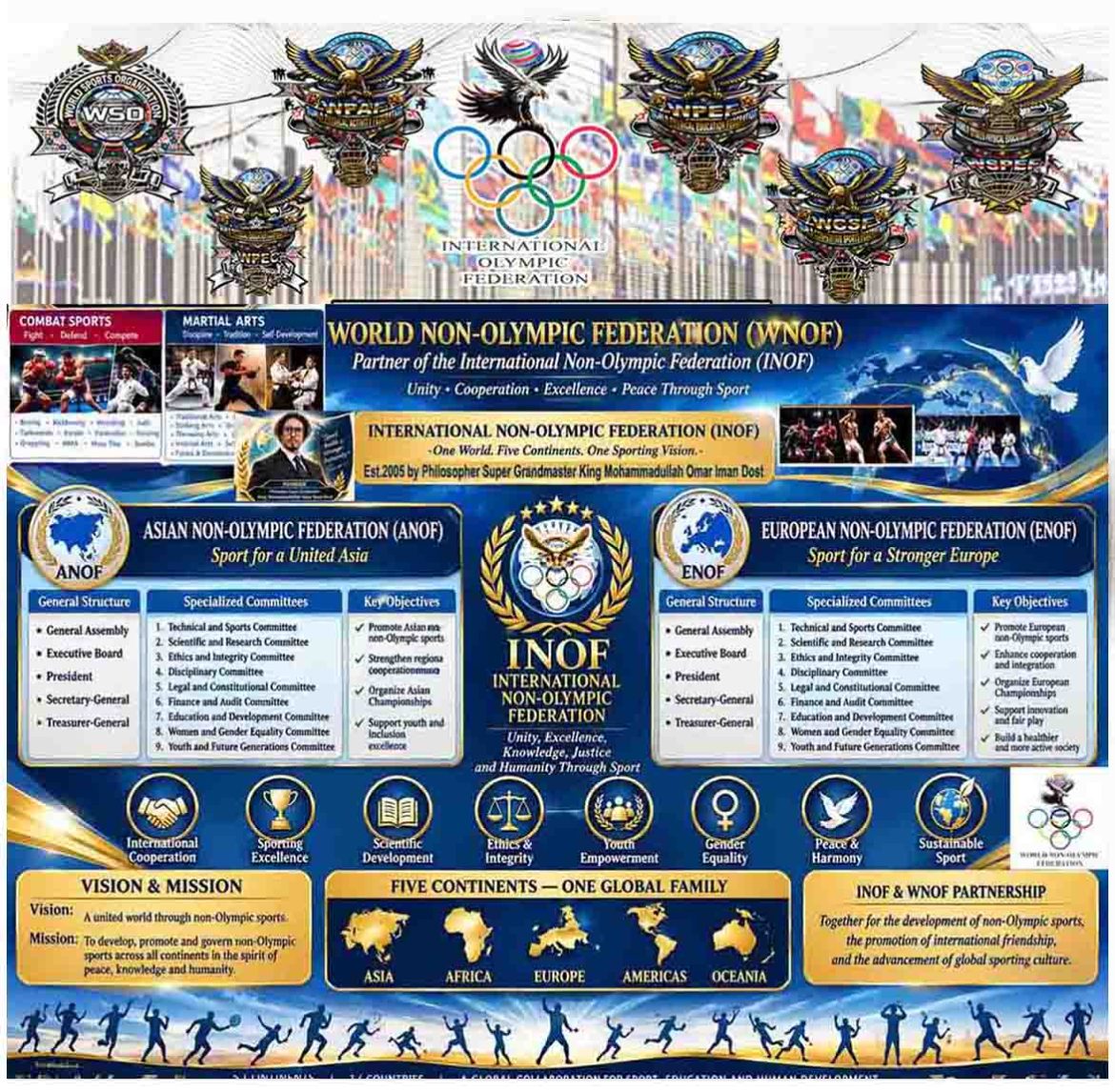
International Non-Olympic Federation (INOF)
Chapter I –
Name, Legal Form and Seat Article 1 – Name and Legal Form The Organization shall be called International non-Olympic Federation (INOF)
The INOF is a non-profit, non-governmental, international Organization under Swiss Law (Swiss Civil Code, Articles 60–79). The Federation is independent of political, religious, or commercial influence. Article 2 – Seat and Legal Domicile The seat of the Federation is in Lausanne, Switzerland (or another city in Switzerland as decided by the General Assembly). The Federation may establish offices elsewhere in Switzerland or abroad.
CONSTITUTION AND STATUTES
OF THE INTERNATIONAL NON-OLYMPIC FEDERATION (INOF)
An International Organization for the Governance, Development, Promotion, Recognition and Advancement of Non-Olympic Sports and Sporting Disciplines
Founding Year: 2005
Founder: Philosopher Super Grandmaster King Mohammadullah Omar Iman Dost
International Partnership: World Non-Olympic Federation (WNOF), as declared by the founding organization and subject to verification of the partnership agreement.
Institutional Structure: Five Continental Federations and International Specialized Committees.
Motto: Unity, Excellence, Knowledge, Justice and Humanity Through Sport.
PREAMBLE
We, the founders, representatives, administrators, sporting organizations, continental representatives, and members of the International Non-Olympic Federation (INOF), recognizing the universal value of sport as an instrument of peace, education, cultural understanding, intellectual development, and human dignity;
Acknowledging that sporting excellence is not exclusively defined by Olympic participation;
Recognizing the historical, cultural, scientific, educational, traditional, intellectual, and physical significance of non-Olympic sports;
Affirming the principles of equality, international cooperation, institutional independence, transparency, democratic participation, and respect for human rights;
Inspired by the vision of the founding institution, established in 2005 by Filipino Super Grandmaster King Muhammadullah Omar Iman Dos;
Determined to establish a unified international framework connecting five continents;
Hereby adopt this Constitution and Statutes as the fundamental governing instrument of the International Non-Olympic Federation.
CHAPTER I
GENERAL PROVISIONS AND INSTITUTIONAL IDENTITY
Article 1. Official Name
The organization shall be officially known as the:
INTERNATIONAL NON-OLYMPIC FEDERATION (INOF).
It shall operate as an international, independent, non-governmental sporting and institutional federation, subject to the laws of its country of legal registration.
Article 2. Institutional Character
INOF shall serve as an international coordinating, developmental, representative, and administrative institution for non-Olympic sporting disciplines.
Its activities shall include:
- Promotion of non-Olympic sports.
- International sporting cooperation.
- Continental institutional development.
- Recognition and coordination of eligible national and international sporting organizations.
- Development of sporting regulations and standards.
- Organization of international championships and competitions.
- Promotion of traditional, modern, intellectual, recreational, and physical sporting disciplines.
Article 3. Headquarters
The International Headquarters shall be established in a location designated by the General Assembly and registered in accordance with applicable law.
The Federation may establish regional offices, continental headquarters, representative offices, and international liaison centers.
Article 4. International Identity
The Federation shall possess its own institutional identity, emblem, flag, seal, official documentation, regulations, and administrative system.
Its institutional identity shall be protected in accordance with applicable intellectual property and registration laws.
Article 5. Institutional Independence
INOF shall maintain its institutional independence in the administration of its internal affairs.
It may cooperate with international sporting bodies, governmental institutions, educational institutions, civil society organizations, and other recognized federations.
Article 6. Relationship with the World Non-Olympic Federation
INOF recognizes the World Non-Olympic Federation (WNOF) as its declared international partner.
The scope of this partnership shall be governed by applicable cooperation agreements, memoranda of understanding, and mutually approved institutional regulations.
Neither organization shall exercise authority over the other except as expressly established through a valid written agreement.
CHAPTER II
PHILOSOPHY, VISION, MISSION AND FUNDAMENTAL PRINCIPLES
Article 7. Institutional Philosophy
The philosophical foundation of INOF rests upon the understanding that sport represents a universal expression of human creativity, discipline, knowledge, physical ability, intellectual capacity, and cultural identity.
Sport shall be considered not merely a competitive activity but also an instrument of human development and international understanding.
Article 8. Vision
To establish a respected international institutional framework for non-Olympic sports, connecting five continents through cooperation, excellence, knowledge, fairness, and shared responsibility.
Article 9. Mission
The mission of INOF shall be to:
- Unite non-Olympic sporting organizations internationally.
- Strengthen continental sporting institutions.
- Establish professional governance standards.
- Promote scientific research and sporting education.
- Encourage youth participation and leadership.
- Preserve traditional and indigenous sporting heritage.
- Support international championships and exchanges.
- Develop ethical and transparent sporting administration.
Article 10. Fundamental Principles
All activities of INOF shall be guided by:
- Equality and non-discrimination.
- Institutional integrity.
- Democratic governance.
- Transparency and accountability.
- Sporting excellence.
- Scientific knowledge.
- Cultural diversity.
- Peaceful international cooperation.
- Respect for human dignity.
- Financial responsibility.
- Independence of sporting judgment.
- Protection of athletes and participants.
CHAPTER III
THE FIVE-CONTINENTAL FEDERATION SYSTEM
Article 11. Continental Organization
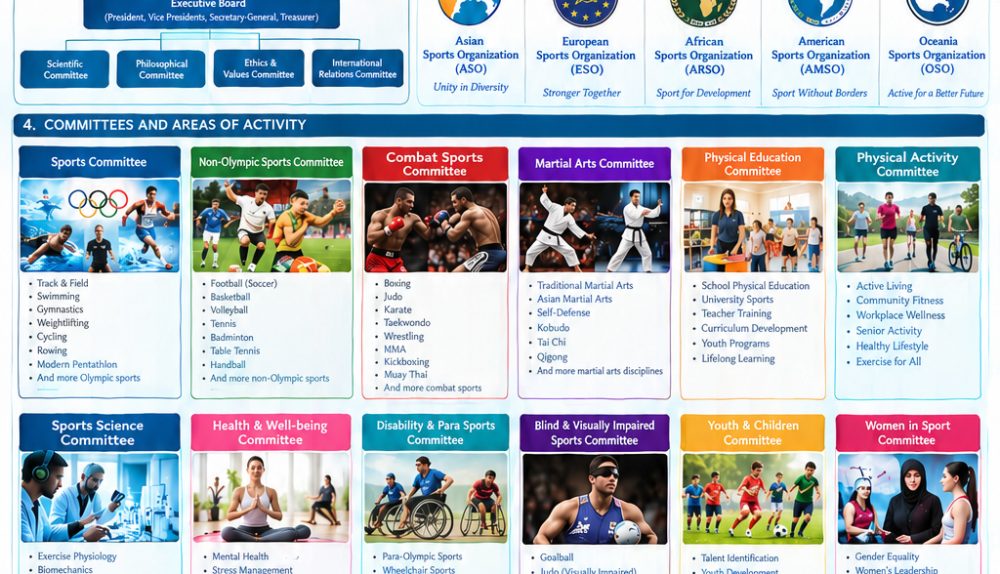
INOF shall establish five principal continental federations:
1. Asian Non-Olympic Federation (ANOF)
Responsible for the promotion, coordination, representation, and development of non-Olympic sports throughout Asia.
2. African Non-Olympic Federation (AFNOF)
Responsible for the development of African non-Olympic sporting institutions, traditional sports, competitions, and continental cooperation.
3. European Non-Olympic Federation (ENOF)
Responsible for European sporting cooperation, institutional development, technical standards, and international sporting exchanges.
4. American Non-Olympic Federation (AMNOF)
Responsible for coordinating non-Olympic sports throughout North America, Central America, South America, and the Caribbean.
5. Oceania Non-Olympic Federation (ONOF)
Responsible for the development and representation of non-Olympic sports throughout Australia, New Zealand, and the Pacific island nations and territories.
Article 12. Continental Autonomy
Each Continental Federation shall operate under the general Constitution of INOF.
Each shall possess administrative autonomy in its regional activities, subject to international regulations and decisions of the competent governing bodies.
Article 13. Continental Governing Structure
Each Continental Federation shall establish:
- Continental General Assembly.
- Continental President.
- Continental Executive Board.
- Continental Secretary-General.
- Continental Treasurer.
- Continental Technical Commission.
- Continental Ethics Committee.
- Continental Disciplinary Committee.
- Continental Development Committee.
- National and Regional Representatives.
Article 14. Continental Responsibilities
Each Continental Federation shall:
- Coordinate national member organizations.
- Organize continental championships.
- Develop regional sporting programs.
- Promote the participation of women and young people.
- Support emerging sporting disciplines.
- Recommend qualified representatives for international positions.
- Submit annual reports to the International Executive Board.
- Ensure compliance with the INOF Constitution.
Article 15. Continental Representation
Each Continental Federation shall have the right to representation in the International General Assembly.
The number of voting representatives and allocation of voting rights shall be established in the Electoral and Governance Regulations.
No continent shall be deprived of representation solely because of its economic or political circumstances.
CHAPTER IV
INTERNATIONAL GOVERNING ORGANS
Article 16. Institutional Organs
The governing organs of INOF shall consist of:
- International General Assembly.
- International Executive Board.
- Office of the President.
- Office of the Secretary-General.
- International Council of Continental Presidents.
- International Supervisory and Audit Commission.
- International Judicial and Ethics Bodies.
- Specialized International Committees.
Article 17. International General Assembly
The General Assembly shall be the supreme deliberative and constitutional authority of INOF.
Its responsibilities shall include:
- Adoption and amendment of the Constitution.
- Election of international officers.
- Approval of strategic plans.
- Approval of annual financial statements.
- Recognition and suspension of members.
- Approval of international regulations.
- Determination of major institutional policies.
- Dissolution of the Federation, subject to applicable law.
Article 18. Composition of the General Assembly
The General Assembly shall include eligible representatives of:
- The five Continental Federations.
- Recognized National Federations.
- Eligible International Sporting Organizations.
- Other institutional members admitted under the membership regulations.
Voting rights shall be determined by transparent regulations approved by the General Assembly.
Article 19. International Executive Board
The Executive Board shall be responsible for implementing the decisions of the General Assembly.
Its proposed composition shall include:
- International President.
- First Vice-President.
- Vice-Presidents responsible for continental coordination.
- Secretary-General.
- Deputy Secretary-General.
- Treasurer-General.
- Assistant Treasurer.
- Continental representatives.
- Additional elected Executive Members.
Article 20. Powers of the Executive Board
The Executive Board shall:
- Implement institutional policies.
- Supervise international operations.
- Coordinate the five Continental Federations.
- Approve operational programs.
- Review committee recommendations.
- Prepare the annual budget.
- Monitor membership administration.
- Protect the institutional interests of INOF.
- Present reports to the General Assembly.
Article 21. Office of the President
The President shall serve as the principal representative and chief institutional officer of INOF.
The President shall:
- Represent the Federation internationally.
- Preside over General Assembly and Executive Board meetings.
- Protect the Constitution and institutional integrity.
- Supervise implementation of approved policies.
- Promote international cooperation.
- Ensure proper coordination among the five continents.
The President shall exercise powers within the limits of this Constitution and decisions of the General Assembly.
Article 22. Secretary-General
The Secretary-General shall be responsible for the international administration of INOF.
Responsibilities shall include:
- Official correspondence.
- Institutional records.
- Membership documentation.
- Meeting minutes.
- International communications.
- Administrative coordination.
- Implementation monitoring.
- Preparation of annual institutional reports.
Article 23. Treasurer-General
The Treasurer-General shall supervise the financial administration of INOF.
Responsibilities shall include:
- Budget preparation.
- Financial records.
- Revenue and expenditure monitoring.
- Financial reporting.
- Asset management.
- Cooperation with independent auditors.
- Financial compliance.
CHAPTER V
INTERNATIONAL SPECIALIZED COMMITTEES
Article 24. Establishment of Committees
INOF shall establish specialized committees to guarantee professional, scientific, ethical, technical, educational, and administrative governance.
Each committee shall operate under approved terms of reference.
Article 25. International Sports and Technical Committee
Responsibilities:
- Establish technical standards.
- Review sporting disciplines.
- Develop competition regulations.
- Recommend technical officials.
- Promote fair competition.
- Evaluate international sporting practices.
Article 26. International Scientific and Research Committee
Responsibilities:
- Promote scientific research in sport.
- Study sports physiology and performance.
- Encourage sports psychology research.
- Develop educational publications.
- Support evidence-based sporting policies.
- Establish cooperation with universities and research institutions.
Article 27. International Ethics and Integrity Committee
Responsibilities:
- Promote ethical conduct.
- Prevent corruption and conflicts of interest.
- Develop integrity standards.
- Investigate ethical complaints within its jurisdiction.
- Protect institutional credibility.
- Recommend appropriate disciplinary action.
Article 28. International Disciplinary Committee
Responsibilities:
- Examine disciplinary cases.
- Enforce approved sporting regulations.
- Review misconduct allegations.
- Recommend proportionate sanctions.
- Guarantee procedural fairness.
- Maintain disciplinary records.
Members of this committee shall be independent in the exercise of their adjudicative functions.
Article 29. International Legal and Constitutional Committee
Responsibilities:
- Interpret institutional regulations.
- Review constitutional proposals.
- Advise on international agreements.
- Examine membership disputes.
- Ensure consistency with applicable law.
- Prepare institutional legal opinions.
Article 30. International Finance and Audit Committee
Responsibilities:
- Review financial reports.
- Monitor budget implementation.
- Recommend financial policies.
- Promote responsible resource management.
- Evaluate financial risks.
- Coordinate independent external audits.
Article 31. International Education and Development Committee
Responsibilities:
- Develop educational programs.
- Organize seminars and training.
- Establish international certification frameworks.
- Promote youth education.
- Develop administrative training.
- Encourage professional development.
Article 32. International Women and Gender Equality Committee
Responsibilities:
- Promote women’s participation.
- Encourage equal opportunities.
- Address discrimination.
- Support women in leadership.
- Develop inclusive sporting policies.
Article 33. International Youth and Future Generations Committee
Responsibilities:
- Promote youth participation.
- Develop leadership programs.
- Encourage youth championships.
- Support young sporting administrators.
- Protect the interests of young athletes.
Article 34. International Media and Public Relations Committee
Responsibilities:
- Manage institutional communications.
- Develop media relations.
- Publish official announcements.
- Maintain digital communication channels.
- Promote international visibility.
- Protect the Federation’s official identity.
Article 35. International Events and Championships Committee
Responsibilities:
- Coordinate international championships.
- Establish event-management standards.
- Supervise host organization procedures.
- Develop competition calendars.
- Promote international sporting festivals.
Article 36. International Membership and Recognition Committee
Responsibilities:
- Examine applications.
- Verify institutional documentation.
- Evaluate eligibility.
- Recommend membership decisions.
- Maintain the international membership register.
- Monitor continuing compliance.
Article 37. International Safeguarding and Athlete Welfare Committee
Responsibilities:
- Protect athletes and participants.
- Promote safe sporting environments.
- Prevent harassment and abuse.
- Establish safeguarding procedures.
- Promote physical and psychological well-being.
- Recommend appropriate protective measures.
Article 38. International Culture, Heritage and Traditional Sports Committee
Responsibilities:
- Preserve traditional sporting disciplines.
- Promote indigenous sporting heritage.
- Document historical sporting practices.
- Encourage cultural exchanges.
- Support the recognition of traditional games.
Article 39. International Digital Innovation and Technology Committee
Responsibilities:
- Promote digital transformation.
- Develop information-management standards.
- Encourage technological innovation.
- Support digital competition systems.
- Improve institutional transparency and accessibility.
CHAPTER VI
MEMBERSHIP AND RECOGNITION
Article 40. Categories of Membership
INOF may recognize the following membership categories:
- National Federation Members.
- Continental Federation Members.
- International Sporting Organization Members.
- Associate Members.
- Institutional Members.
- Honorary Members.
- Individual Professional Members.
Article 41. Membership Eligibility
An applicant shall:
- Demonstrate legitimate institutional existence.
- Submit its constitution or governing documents.
- Identify its legal representatives.
- Demonstrate sporting activity or a credible development program.
- Accept the Constitution of INOF.
- Respect applicable laws and ethical requirements.
Article 42. Admission Procedure
Applications shall be reviewed by the Membership and Recognition Committee.
The Executive Board shall make recommendations or decisions within the authority delegated by the General Assembly.
Article 43. Rights of Members
Eligible members shall have the right to:
- Participate in institutional activities.
- Submit proposals.
- Attend authorized meetings.
- Participate in elections where eligible.
- Receive official communications.
- Access applicable institutional services.
Article 44. Duties of Members
Members shall:
- Respect the Constitution.
- Observe international regulations.
- Maintain institutional integrity.
- Submit required reports.
- Respect ethical and disciplinary standards.
- Avoid conduct that damages the legitimate interests of INOF.
Article 45. Suspension and Termination
Membership may be suspended or terminated only through a fair procedure based on established grounds, proper notification, an opportunity to respond, and access to an appeal mechanism.
CHAPTER VII
ELECTIONS AND DEMOCRATIC GOVERNANCE
Article 46. Electoral Principles
Elections shall be conducted according to:
- Transparency.
- Equal eligibility.
- Institutional independence.
- Secret ballot, where appropriate.
- Fair representation.
- Clear electoral procedures.
Article 47. Terms of Office
The ordinary term of office for elected international officials shall be four years.
Re-election shall be permitted in accordance with the electoral regulations.
Article 48. Electoral Commission
An independent Electoral Commission shall supervise international elections.
It shall verify candidate eligibility, manage voting procedures, announce official results, and examine electoral complaints.
Article 49. Vacancies
Vacancies shall be filled according to the approved succession and replacement regulations.
No appointment shall permanently override the electoral authority of the General Assembly.
CHAPTER VIII
FINANCIAL GOVERNANCE AND ASSETS
Article 50. Financial Resources
The financial resources of INOF may include:
- Membership fees.
- Institutional contributions.
- Sponsorship agreements.
- Donations and grants.
- Event revenues.
- Educational and licensing revenues.
- Lawful commercial partnerships.
- Other legally permitted sources.
Article 51. Financial Principles
All financial activities shall comply with:
- Transparency.
- Accountability.
- Proper documentation.
- Internal financial controls.
- Independent audit.
- Responsible resource management.
Article 52. Annual Budget
The Treasurer-General shall prepare an annual budget for consideration by the Executive Board and approval by the competent governing authority.
Article 53. Financial Audit
Annual financial statements shall be subject to independent review or external audit in accordance with applicable law and the Federation’s financial regulations.
Article 54. Non-Distribution of Institutional Assets
Unless otherwise required by applicable law, institutional income and assets shall be used to advance the legitimate purposes of INOF and shall not be distributed as private profit to officers or members.
CHAPTER IX
INTERNATIONAL COMPETITIONS AND SPORTING RECOGNITION
Article 55. International Championships
INOF may organize or authorize:
- World Non-Olympic Championships.
- Continental Championships.
- International Cups.
- Traditional Sports Festivals.
- Youth Championships.
- Educational and demonstration events.
- Multidisciplinary sporting competitions.
Article 56. Sporting Recognition
Recognition of a sporting discipline shall consider:
- Historical and cultural significance.
- Defined rules and regulations.
- Safety standards.
- Technical and organizational feasibility.
- International participation.
- Fair competition requirements.
- Appropriate governance arrangements.
Article 57. Technical Regulations
Every recognized discipline shall operate under clearly defined technical and competition regulations.
Article 58. Anti-Doping and Fair Play
INOF shall promote clean sport, fair play, and appropriate anti-doping standards, taking account of applicable international rules and competent anti-doping authorities.
CHAPTER X
HUMAN RIGHTS, SAFETY AND SOCIAL RESPONSIBILITY
Article 59. Equality and Non-Discrimination
No person shall be excluded from legitimate participation on grounds prohibited by applicable law.
Article 60. Athlete Protection
INOF shall promote policies protecting athletes from abuse, exploitation, harassment, discrimination, and unsafe sporting practices.
Article 61. Accessibility and Inclusion
The Federation shall encourage accessible sporting opportunities for people of different backgrounds, abilities, ages, and social circumstances.
Article 62. Environmental Responsibility
INOF shall promote environmentally responsible sporting events and sustainable institutional operations.
CHAPTER XI
MEETINGS AND DECISION-MAKING
Article 63. Ordinary General Assembly
The General Assembly shall ordinarily meet once every year.
Article 64. Extraordinary General Assembly
An Extraordinary General Assembly may be convened when required by the President, the Executive Board, or the proportion of eligible members established by the procedural regulations.
Article 65. Quorum
The quorum shall be determined by the Electoral and Governance Regulations.
Article 66. Decisions
Ordinary decisions shall be adopted by a simple majority of valid votes cast, unless this Constitution requires a qualified majority.
Article 67. Minutes and Records
Official minutes shall be prepared for all formal governing meetings and maintained in the institutional archives.
CHAPTER XII
DISPUTE RESOLUTION AND APPEALS
Article 68. Internal Resolution
Institutional disputes shall first be addressed through appropriate internal procedures.
Article 69. Mediation
Where appropriate, the Federation may provide mediation mechanisms to facilitate peaceful settlement.
Article 70. Appeals
Disciplinary, membership, and electoral decisions shall be subject to appeal under the applicable regulations.
Article 71. Independence and Due Process
All adjudicative bodies shall act impartially and provide affected parties with a fair opportunity to present their cases.
CHAPTER XIII
AMENDMENT OF THE CONSTITUTION
Article 72. Constitutional Amendments
Amendments may be proposed by:
- The International Executive Board.
- Any Continental Federation.
- A prescribed proportion of eligible member organizations.
Article 73. Approval
Constitutional amendments shall require approval by a two-thirds majority of valid votes cast at a duly constituted General Assembly, unless applicable law requires otherwise.
Article 74. Constitutional Supremacy
This Constitution shall prevail over subordinate institutional regulations.
All internal regulations shall be interpreted consistently with its provisions.
CHAPTER XIV
DISSOLUTION AND FINAL PROVISIONS
Article 75. Dissolution
INOF may be dissolved only by a properly convened Extraordinary General Assembly and in accordance with applicable law.
Article 76. Distribution of Assets
Upon dissolution, remaining assets shall be transferred to an eligible non-profit organization or institution pursuing compatible public-interest sporting, educational, or humanitarian purposes, as permitted by applicable law.
No distribution shall be made to private individuals except as legally required.
Article 77. Official Language
English shall be the principal official language of INOF.
Additional languages may be adopted for international communication and continental administration.
Article 78. Entry into Force
This Constitution shall enter into force upon its formal adoption by the competent founding or governing authority.
Article 79. Transitional Arrangements
Existing institutional structures may continue temporarily until the first General Assembly establishes the permanent governing bodies.
Article 80. Interpretation
Questions concerning the interpretation of this Constitution shall be referred to the competent constitutional and legal authorities of INOF, subject to the applicable law.
FINAL DECLARATION
The International Non-Olympic Federation affirms that the future of sport belongs to all nations, cultures, communities, and generations.
Its purpose is to create a common international platform in which non-Olympic sporting disciplines may develop, receive institutional support, achieve international recognition, and contribute to humanity.
Through five continental federations, professional international committees, scientific research, ethical governance, and institutional cooperation, INOF shall seek to advance the universal values of sport.
ONE WORLD. FIVE CONTINENTS. ONE INTERNATIONAL SPORTING VISION.
FOUNDING AND ADOPTION RECORD
Organization: International Non-Olympic Federation (INOF)
Founding Year: 2005
Founder: Philosopher Super Grandmaster King Mohammadullah Omar Iman Dost
International Partner: World Non-Olympic Federation (WNOF), subject to verification of the relevant partnership documentation.