International Olympic Federation (IOF)
Chapter I: Nature, Status and Governance
Article 1 – Establishment and Definition
International Olympic Federation (IOF).
The Federation operates as an independent, non-profit international organization.
Article 2: Objectives and Missions
To promote and develop Olympic sports and the Olympic philosophy worldwide.
To support the regular organization of the Olympic Games and other recognized international sporting events.
To preserve and uphold Olympic values, including friendship, equality, respect, and the pursuit of individual excellence.
To cooperate with organizations and national and international federations in order to develop both grassroots and professional sports.
Section Two: Membership
Article 3: Types of Membership
Full Membership: Granted to National Olympic Committees and International Sports Federations.
Honorary Membership: Awarded to individuals who have rendered outstanding services to the Federation or to Olympic sports.
Article 4: Admission and Suspension
Admission of members shall be approved by the General Assembly by a majority vote.
Any member may be suspended or expelled in the event of a violation of the IOF Statutes or regulations.
Recognition of and Cooperation with the International Olympic Committee (IOC)
With full emphasis on respect for and cooperation with the International Olympic Committee (IOC) and its regulations:
The International Olympic Federation was founded and established by the genius Master Mohammadullah Omar Iman Dost (known as “The King of the World”) with the objective of cooperation, coordination, and alignment with the International Olympic Committee (IOC), in accordance with the principles and regulations governing the Olympic Movement. The Federation fully recognizes the International Olympic Committee as the highest and most authoritative governing body of the Olympic Movement and is firmly committed to preserving its legal, international, and institutional status.
The International Olympic Federation hereby declares its full respect for and adherence to the Olympic Charter, as well as all rules, regulations, guidelines, and decisions issued by the International Olympic Committee. The Federation is committed to conducting all its activities, programs, and governance in strict compliance with IOC regulations and under the guiding principles of transparency, accountability, and mutual respect.
Furthermore, the International Olympic Federation expresses its readiness for continuous, constructive, and effective cooperation with the International Olympic Committee and all affiliated Olympic bodies, with the aim of safeguarding Olympic values, promoting clean sport, and contributing to the sustainable development and unity of the Olympic Movement worldwide.
The International Olympic Federation firmly believes that full compliance with the rules and guidance of the International Olympic Committee is essential to maintaining the credibility, integrity, and cohesion of the Olympic Movement, and these principles shall remain the foundation of all actions and decisions of the Federation.
The Federation is the highest legislative, executive, supervisory, and disciplinary authority within its jurisdiction.
No national, continental, or international body shall have the right to interfere with the independence of the Federation.
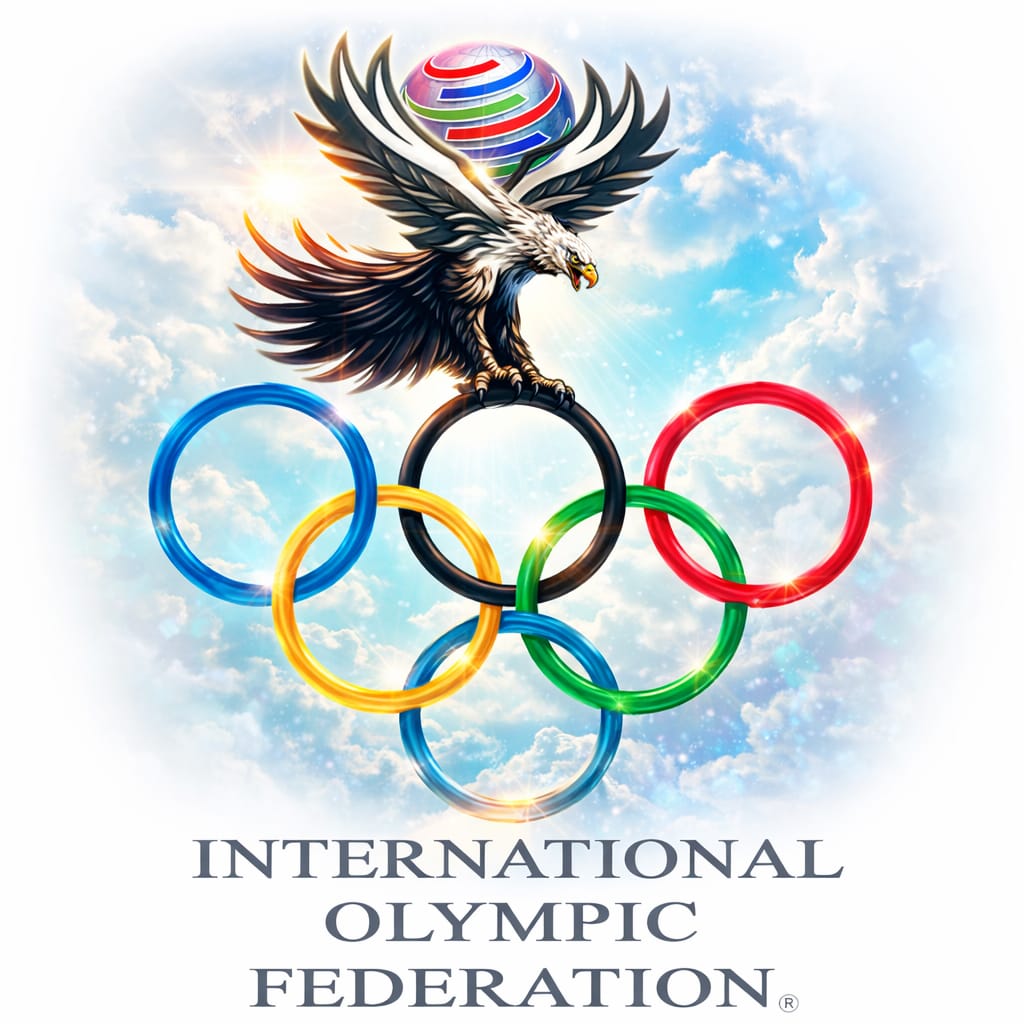
A Deep Interpretation of the Logo (Six Rings + the Globe)
1. The Globe at the Top — “Unity on a Human Scale”
The globe shows that the message of this institution goes beyond countries, politics, and borders.
The moving colored lines on the globe symbolize:
the dynamism of the world,
the circulation of cultures,
the continuous flow of sport among nations.
Here, the world is a shared stage for humanity—a place where competition replaces war.
2. The Six Rings — Redefining Today’s World
Unlike the classic Olympic symbol with five rings, this logo intentionally presents six rings, offering a more modern and more human-centered view of the world.
The first five rings represent the five recognized continents:
Asia
Europe
Africa
the Americas
Oceania
These rings stand for geography.
3. The Sixth Ring — “Humanity Beyond Geography”
The sixth ring carries the most important message of the logo.
It represents something not visible on maps, yet very real in today’s world.
The deeper meaning of the sixth ring:
global peace and shared humanity
It stands for:
refugees,
stateless athletes,
minorities,
people beyond race, religion, and politics.
The sixth ring declares:
“Every human being has a place—even beyond borders.”
4. Interlocking Rings — Coexistence, Not Superiority
The interconnection of the six rings shows that:
no continent or group is superior to another,
strength comes from connection, not separation,
healthy competition has meaning only when it does not erase others.
This message is especially powerful in today’s tense world.
5. The Relationship Between the Rings and the Globe
With the rings below and the globe above, the logo suggests that:
the world turns on cooperation among nations,
sport is the pillar of human connection,
sporting decisions have global consequences.
The globe without the rings is lifeless,
and the rings without the globe are meaningless.
Final Message of the Logo
This logo says:
“The world is not made only of continents;
the world is made of people.”
Article 2 – Legal Personality
The Federation possesses full international legal personality.
The Federation shall have the right to:
Issue binding regulations
Grant, suspend, or revoke membership
Recognize or cancel international competitions
Impose sporting and disciplinary sanctions
Article 3 – Independence
The Federation is independent from governments, political parties, and religious institutions.
Any form of political interference in the affairs of the Federation is strictly prohibited.
Chapter II: Scope of Jurisdiction and Exclusive Powers
Article 4 – Global Jurisdiction
The jurisdiction of the Federation extends to all countries, regions, and continents worldwide.
Article 5 – Exclusive Powers
The Federation shall have exclusive authority to:
Adopt and interpret Olympic and technical regulations
Establish licensing systems for international competitions
Approve the official global competition calendar
Validate or annul official records, titles, and results
Recognize national federations
Chapter III: Legal Nature, Seat and Duration
Article 6 – Legal Status
The Federation is an international, independent, non-governmental, non-profit, and non-political organization.
It enjoys full legal personality in accordance with the Olympic Charter, international law, and the laws of the country of registration.
The Federation holds legislative, executive, supervisory, judicial sporting, and ownership authority.
Its decisions are binding upon all members.
Article 7 – Sovereignty and Autonomy
The Federation is fully independent from political, governmental, economic, or religious influence.
No external body may invalidate, suspend, or interpret the decisions of the Federation except as provided by these Statutes.
Article 8 – Seat
The official seat of the Federation shall be in Geneva, Swiss Confederation.
The Federation may establish continental, regional offices and official representations worldwide.
Article 9 – Term
The duration of the Federation shall be unlimited.
Chapter IV: Fundamental Principles and Charter
Article 10 – Fundamental Principles
The Federation shall be governed by the following principles:
Rule of sports law
Equality and non-discrimination
Respect for human dignity
Transparency, accountability, and good governance
Fair Play
Sustainable development of sport
Protection of athletes
Article 11 – Olympic Charter of the Federation
These Statutes constitute the Supreme Charter of the Federation.
All regulations, by-laws, and codes shall derive their authority from and comply with these Statutes.
Chapter V: Objectives, Mission and Exclusive Authority
Article 12 – Strategic Objectives
Global leadership and governance of Olympic sports
Establishment of universal technical and ethical standards
Organization and licensing of international events
Protection and support of athletes, coaches, and officials
Promotion of peace and global coexistence through sport
Article 13 – Exclusive Authority
The Federation shall have exclusive authority to:
Enact technical, disciplinary, ethical, and commercial regulations
Recognize or suspend national federations
Approve or annul official results, records, and titles
Determine the global competition calendar
Impose sporting and disciplinary sanctions
Own all commercial, media, and branding rights
Chapter VI: Federal Structure and Membership
Article 14 – Federal Structure
The Federation operates under a federal system; members enjoy internal autonomy while remaining subject to the supreme authority of the Federation.
Article 15 – Categories of Membership
Full Members: National Olympic Federations (sole official representative per country)
Continental Members: Continental unions
Honorary Members: Distinguished individuals (without voting rights)
Article 16 – Principle of National Exclusivity
Only one national federation per country may be recognized as a member.
Chapter VII: Governing Bodies of the Federation
Article 17 – Organs
General Assembly (Legislative Authority)
Executive Council (Executive Authority)
President
Secretary General
Standing Committees
Independent Judicial and Oversight Committees
Chapter VIII: General Assembly
Article 18 – Status
The General Assembly is the supreme legislative authority of the Federation.
Article 19 – Powers
Adoption and amendment of the Statutes
Election and removal of the President and Executive Council
Approval of strategic policies
Approval of budgets and financial reports
Decisions on suspension or expulsion of members
Chapter IX: Executive Council
Article 20 – Composition
The Executive Council consists of the President, Vice Presidents, Secretary General, and elected members.
Article 21 – Powers
Overall administration of the Federation
Implementation of laws and resolutions
Supervision of members
Financial and administrative management
اتخاذ decisions in emergency situations
Chapter X: President and Secretary General
Article 22 – President
The President is the highest authority of the Federation.
He/she is the official global representative of the Federation.
The President holds final signature authority over all binding instruments.
Article 23 – Secretary General
The Secretary General is the chief executive officer of the Federation.
He/she manages the Secretariat and implements decisions.
The Secretary General is accountable to the Executive Council.
Chapter XI: Committees
Article 24 – Standing Committees
Technical Committee
Referees Committee
Education and Development Committee
Medical and Anti-Doping Committee
Athletes’ Committee
Equality and Inclusion Committee
Article 25 – Independent Committees
Ethics Committee
Disciplinary Committee
Audit Committee
Compliance and Governance Committee
(fully independent from executive bodies)
Chapter XII: Judicial, Disciplinary and Ethical System
Article 26 – Judicial Authority
The Federation has internal sporting judicial authority, and its decisions shall be enforceable.
Article 27 – Sanctions
Warning
Fine
Suspension
Temporary or permanent ineligibility
Revocation of membership
Chapter XIII: Financial Affairs and Commercial Rights
Article 28 – Financial Resources
Membership fees
Sponsorship
Media and broadcasting rights
Competition revenues
Lawful international grants
Article 29 – Commercial Ownership
All rights to the name, emblem, brand, and events belong exclusively to the Federation.
Chapter XIV: Dispute Resolution
Article 30 – Final Jurisdiction
The Court of Arbitration for Sport (CAS) shall be the final authority for dispute resolution.
Chapter XV: Amendments, Dissolution and Final Provisions
Article 31 – Amendments
Amendments require approval by at least two-thirds of the General Assembly.
Article 32 – Dissolution
Dissolution requires approval by three-quarters of the General Assembly.
Article 33 – Entry into Force
These Statutes shall enter into force upon approval by the General Assembly.